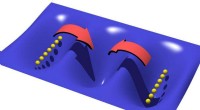
Sound waves travel faster in solids than in gases because the particles in a solid are much closer together and interact more strongly than those in a gas.
Explanation:
* Intermolecular Forces: The particles in a solid are held together by strong intermolecular forces. This creates a rigid structure where particles are tightly packed. In contrast, gas particles are far apart and their interactions are weak.
* Vibrational Transfer: Sound waves travel by transferring vibrations from one particle to another. In solids, the close proximity of particles allows for efficient transfer of these vibrations. The strong intermolecular forces enhance this transfer, leading to faster propagation of the sound wave.
* Compression and Expansion: Sound waves consist of compressions and rarefactions (expansion) of the medium. In solids, the rigid structure makes it easier for these compressions and rarefactions to occur quickly, further contributing to the faster speed of sound.
* Bulk Modulus: The bulk modulus is a measure of a material's resistance to compression. Solids have a higher bulk modulus than gases, making them more resistant to compression and allowing sound waves to travel faster.
Therefore, the close proximity of particles, strong intermolecular forces, and higher bulk modulus in solids allow sound waves to travel faster than in gases.