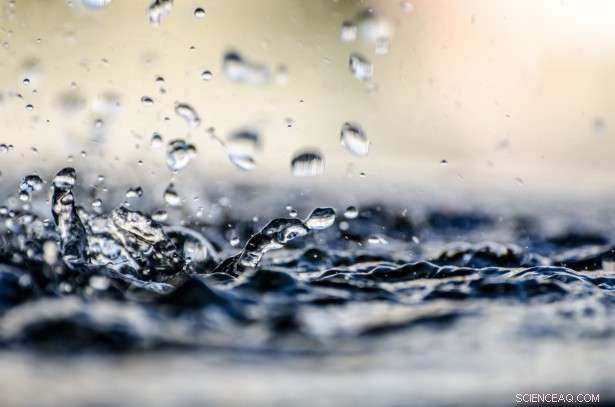
Credit: George Hodan/public domain
Two teams of researchers working independently of one another have discovered some remarkable features of liquid water—it can be chilled to −42.55°C and it appears to have what is described as a singularity. The first team, made up of members from across Europe, conducted experiments designed to find the lowest temperature at which liquid water can exist. They have published their results in the journal Physical Review Letters. The second team, with members from Sweden, Korea and Japan sought to learn more about the attributes of liquid water when chilled to very low temperatures. They have published their results in the journal Science. Paola Gallo with Università Roma Tre and Eugene Stanley with Boston University offer a Perspective piece on the work done by the two teams in the same Science issue.
While it is true that liquid water normally becomes a solid at 0°C, it is also true that under certain circumstances, liquid water can be much colder than that, such as when it is chilled very quickly—a fast measuring system can take the temperature of the water before it has time to form crystals. But just how cold can it get? Prior theory has suggested the limit is likely −40°C. I this new effort, the researchers found it could go slightly colder than that by injecting very tiny droplets into a vacuum chamber. As the droplets moved through the chamber, some of the water evaporated, causing the temperature of the drop to fall. The team used lasers to measure the change in diameter of the drops to calculate their temperature, and found the new low record of −42.55°C.
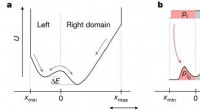
Liquid water also has another strange property, according to the researchers with the second effort—the ability to exist in two different liquid states when chilled and to jump between them at a given point, which the team called its singularity. They used a similar setup to the first group, injecting water droplets into a vacuum chamber and shooting them with a laser to measure their temperature, but they found something new. Different parts of the droplets had different densities and sometimes the molecules in the drops seemed to have difficulty deciding which state to occupy, and so moved back and forth, suggesting a singularity state.
© 2018 Phys.org