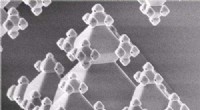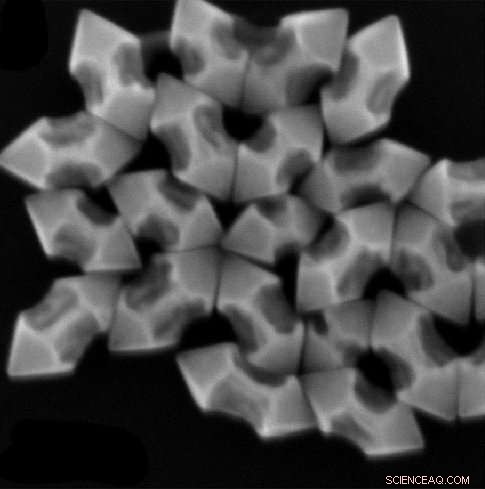
Scanning electron microscope image of gold nanoarrows. Credit: Wang et al., Sci. Adv. 2017;3: e1701183
(Phys.org)—A team of researchers at Peking University has found that tiny arrows made of gold can be used to create exotic new superstructures. In their paper published on the open access site Science Advances, the team describes how the nano-arrows were formed and how they can be used to create 2-D and 3-D supercrystals.
As the search for new useful materials continues, scientists have looked to unusual constructs as a basis upon which to build other objects. One specific area of research involves searching for materials that behave in certain ways at the nano-level, particularly those that respond to light (nanophotonics). This is an area, the researchers note, that is lacking in the production of nanocrystals that are adjustable and complex enough to meet the needs of the growing field. In this new effort, the group has developed a new type of building block for creating such materials—called nano-arrows, they can be used to create unique crystal formations.
The nano-arrows, the team explains were formed from twin pyramids of gold connected on either end to a four-wing shaft also made of gold—the team calls them uniform gold nano-arrows (GNAs). They were made using a controlled gold nanorod overgrowth process. The result is an extremely tiny two-point arrow with tips pointing in opposite directions. The unique shape, the researchers note, and the fact that they are uniform, allows for the construction of unique assemblages. When laid flat, the GNAs can align face to face, allowing for the construction of interesting and possibly useful 2-D web supercrystals, some of which resemble zippers and others woven cloth.
By using the 2-D constructs as a basis, the team further notes, it is possible to create closely packed 3-D supercrystals with varying degrees of packing or pore structure. They note also that applying electromagnetic stimulation to such crystals results in the growth of exotic crystal patterns—this method, the team claims, could open the door to new avenues of research involving self-assembling nano-particles superstructures. They further add that end products might include novel plasmonic metamaterials suitable for use in nanophotonics or reconfigurable architectural materials.
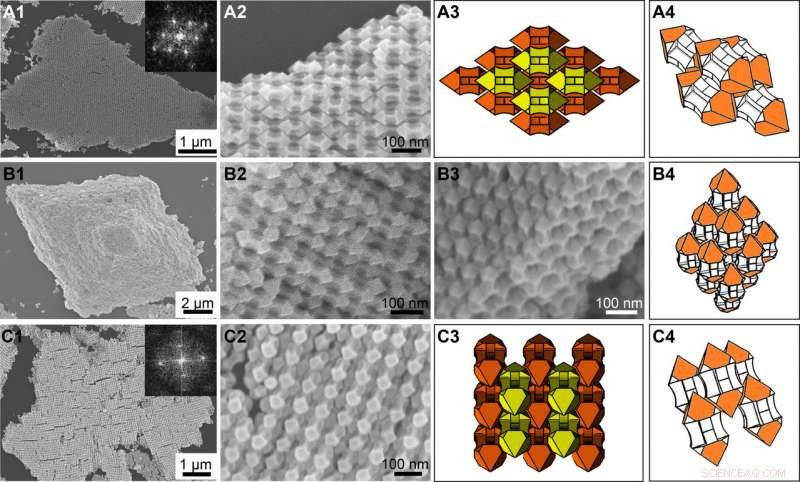
3D SCs assembled by GNAs. SEM images (A1, A2, B1, B2, B3, C1, and C2) and geometric models (A3, A4, B4, C3, and C4) of Net III (A1 to B4) and Weave III (C1 to C4) SCs. Insets show the corresponding FFT patterns. Facets lying against the facets of neighboring GNAs are painted in saffron in (A4), (B4), and (C4). Credit: Wang et al., Sci. Adv. 2017;3: e1701183
© 2017 Phys.org