Seismic age determination is a technique used to estimate the age of stars, including the Sun, based on their seismic properties. Asteroseismology, the study of stellar oscillations, allows scientists to probe the internal structure of stars and infer their age by analyzing the frequencies of these oscillations.
The Sun, being the closest star to Earth, offers a unique opportunity for detailed asteroseismic observations. However, the Sun's magnetic activity introduces complexities in the interpretation of seismic data. Magnetic activity can generate additional sources of energy that contribute to solar oscillations, affecting the seismic age determination.
In their study, the MPS team used high-precision seismic data obtained from the space-based NASA/ESA Solar and Heliospheric Observatory (SOHO) and the ground-based Global Oscillation Network Group (GONG) to investigate the influence of magnetic activity on the Sun's seismic age.
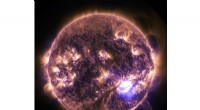
They analyzed the variations in the seismic frequencies over the 11-year solar activity cycle, which ranges from periods of low activity to periods of high activity, characterized by the appearance of sunspots and flares on the Sun's surface.
The results revealed that the Sun's seismic age varies with the level of magnetic activity. During periods of low magnetic activity, the Sun appears younger, while during periods of high activity, it appears older. This behavior can be attributed to the changes in the Sun's internal structure and energy transport mechanisms caused by magnetic activity.
The variations in the Sun's seismic age were found to be particularly significant in the outer layers of the Sun, where the magnetic activity is more pronounced. The team also observed a correlation between the seismic age variations and the number of sunspots, providing further evidence for the influence of magnetic activity.
These findings highlight the importance of considering magnetic activity when determining the Sun's seismic age. By incorporating the effects of magnetic activity into seismic age calculations, scientists can obtain more accurate estimates of the Sun's age and gain a deeper understanding of its internal dynamics and evolution.
The study contributes to the body of knowledge regarding the Sun's seismic properties and provides valuable insights into the interplay between magnetic activity and stellar oscillations. It also underscores the value of long-term, high-precision seismic observations in unraveling the mysteries of our closest star.