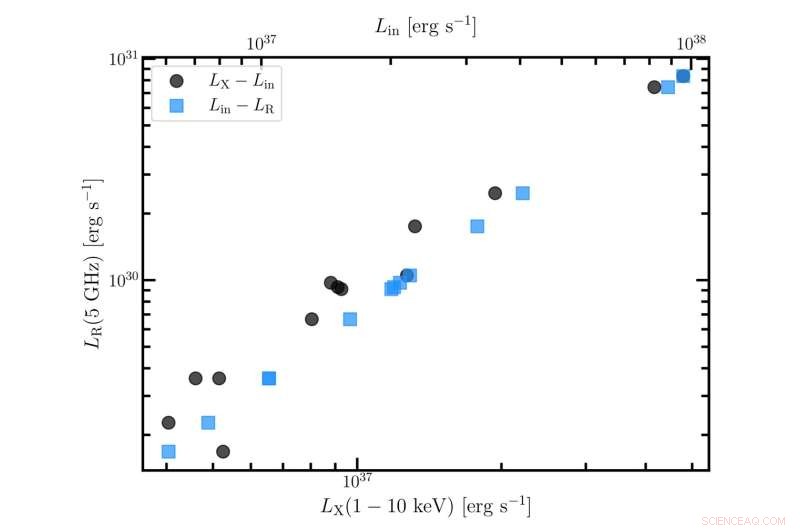
Radio/X-ray correlation for the ‘outlier’ track of H1743-322 (in the upper x-axis, the inner-disk luminosity is Lin). The black circles represent the observed radio/X-ray correlation, while the blue squares represent the radio/inner-disk correlation where the inner-disk luminosity is calculated using Equations (4) and (5). Credit: Universe (2022). DOI: 10.3390/universe8060333
Black hole X-ray binaries (BHXB) comprise a stellar-mass black hole accreting gas from a companion star and emitting transient X-ray emission and compact radio jets.
There are strong correlations between the radio luminosity LR and the X-ray luminosity LX of BHXBs. The correlations can mainly be divided into the "standard" track and the "outliers" track.
A research team from the Xinjiang Astronomical Observatory (XAO) of the Chinese Academy of Sciences (CAS) has investigated the contribution of the black hole spin to jet power (Blandford-Znajek jet, hereafter BZ-jet), especially for the magnetic arrested disk, and found that BZ-jet and the inner-disk coupling could account for the "outliers" track in BHXBs.
The study was published in Universe.
The researchers used the quasi-simultaneous radio and X-ray luminosity to probe the accretion of the "outlier" track in two BHXBs, H1743-322 and MAXI J1348-630. The BZ-jet and the inner-disk coupling showed good consistency with the observed radio/X-ray correlation in both sources. This suggests that the BZ-jet may explain the "outlier" tracks of both sources.
While the accretion disk of H1743-322 in outburst could be in the magnetic arrested disk state, there is a lower possibility that a magnetic arrested disk is achieved in MAXI J1348-630 due to its low jet production efficiency.
The difference in inner-disk luminosity to bolometric luminosity ratio for H1743-322 and MAXI J1348-630 was 0.191±0.081 and 0.011±0.005, respectively, which implies that MAXI J1348-630 is in a relatively low state compared with H1743-322. + Explore further