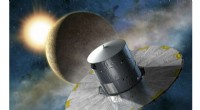
The Phi-sat-1 satellite, which was launched from the Baikonur Cosmodrome in Kazakhstan on August 2, is equipped with an AI processor that will allow it to autonomously process data collected from its sensors.
This will enable the satellite to identify and track objects of interest, such as ships or aircraft, and to generate alerts in near real-time.
The satellite will also be able to learn and adapt over time, improving its performance as it gains more experience.
This will allow it to identify and track objects that are difficult to detect using traditional methods, such as small satellites or drones.
The Phi-sat-1 satellite is a joint project between ESA and the German Aerospace Center (DLR).
It is the first satellite to be equipped with an AI processor that is capable of autonomously processing data from multiple sensors.
The satellite will be used to demonstrate the potential of AI for Earth observation and to pave the way for future missions that use AI to improve their performance.
"The Phi-sat-1 satellite is a major milestone in the development of AI for Earth observation," said Josef Aschbacher, ESA's Director of Earth Observation Programmes.
"This satellite will demonstrate how AI can be used to improve the efficiency and accuracy of Earth observation, and to open up new possibilities for applications such as environmental monitoring, disaster response, and security."
The Phi-sat-1 satellite is expected to remain in orbit for at least two years.
During that time, it will collect data from its sensors and use its AI processor to autonomously process the data and generate alerts.
The data from the satellite will be made available to researchers and developers, who will be able to use it to develop new AI algorithms and applications for Earth observation.
"The Phi-sat-1 satellite is a game changer for Earth observation," said Andreas Knobloch, Head of DLR's Space Administration.
"This satellite will revolutionize the way we collect and process data from space, and will enable us to develop new applications that will benefit society."