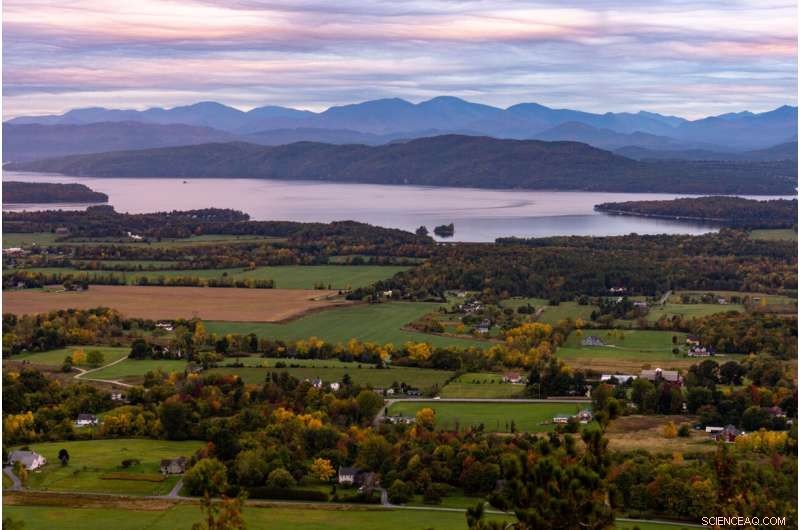
Overlooking Champlain Valley in Vermont, facing westward durring sunrise. Unsplash/CC0 Public Domain
Vermont is becoming warmer and wetter due to climate change—and these trends are reshaping life in the Green Mountain State.
That's the big takeaway of the most comprehensive study of climate change in Vermont, the Vermont Climate Assessment 2021. The University of Vermont study finds the state's average annual temperature has warmed by nearly 2°F, and precipitation has increased by a whopping 21%, since 1900.
Released today, the study is Vermont's first state climate assessment since 2014—and shows that many hallmarks of Vermont life are being impacted by climate change, from farming and maple syrup to long winters and skiing.
The study is also the latest evidence of significant warming and increased precipitation in the U.S. Northeast due to climate change.
"Climate change is here—and impacting communities across Vermont," says UVM climate scientist Gillian Galford, lead author of the Vermont Climate Assessment 2021. "Our goal is to give Vermonters the tools they need to better prepare for climate change."
For the study, researchers analyzed the latest climate science to investigate impacts across 10 key sectors of Vermont society, including: health, water, food and agriculture, energy, transportation, forests, tourism and recreation, fish and wildlife, and more.
Below are some key findings (more results available online at vtclimate.org):
While Vermont's climate is expected to remain attractive compared to many regions, temperatures and precipitation have increased faster than previously projected in the 2014 climate assessment. Greater warming and precipitation are expected in the future, with greater variability, periods of intense precipitation, and prolonged dry spells and droughts, the authors say.
While the study focused on Vermont, the researchers say it reflects larger climate change trends across New England and the U.S. Northeast, which is experiencing a drastic increase in precipitation and heavier storms.
"As the local impacts of our changing climate continue to be quantified and measured across Vermont, the Vermont Climate Assessment is a timely compendium of these effects," says UVM's Lesley-Ann Dupigny-Giroux, Vermont's State Climatologist, and author of the next National Climate Assessment's water chapter. "It will assist stakeholders in their decision-making about mitigating against, and adapting to, climate change," adds Dupigny-Giroux, who was invited by the U.S. government to participate in the United Nations' COP26.
To address the growing risk of floods and droughts, the study recommends greater planning and investment in infrastructure for managing water, stormwater, and irrigation. Planning is crucial to prepare for current and future climate change impacts, and for accessing federal funding, researchers say.
"We want to help people to feel more prepared, to make better decisions—and be more resilient to climate change," says Joshua Faulkner of UVM's College of Agriculture and Life Sciences and UVM Extension, who co-led the project.
To slow the impacts of climate change, the study also recommends steep reductions in greenhouse gas (GHG) emissions, especially in the state's two largest sources of emissions and energy use: transportation and heating. Electrifying these sectors can significantly reduce Vermont's carbon footprint, researchers say, especially since Vermont's electricity has the lowest carbon intensity in the country.
The findings are being made available to the Vermont Climate Council, which is drafting a state Climate Action Plan by December 1, 2021. Vermont's Global Warming Solutions Act requires greenhouse gas emissions reductions by 26% below 2005 levels by 2025, 40% below 1990 levels by 2030, and 80% below 1990 levels by 2050.
The team interviewed and surveyed over 150 citizens, state officials, business leaders, and stakeholders to inform the study. They found many examples of climate action, including greater use of electric cars and solar and wind energy, low-carbon agriculture, promising new Vermont-made electric aircraft technology, experimental snow storage to extend ski seasons, and communities and farmers improving their stormwater management in preparation for climate change.
Besides traditional data sources, the researchers also used unique, hyperlocal sources, such as data from the Joe's Pond ice-out competition in Northern Vermont, where locals have bet on when the pond thaws since the 1980s.