Why this happens:
* Gravity's Pull: Gravity pulls on all objects with the same force per unit of mass. This means a heavier object experiences a stronger gravitational force, but it also has more inertia (resistance to change in motion). These two effects cancel each other out.
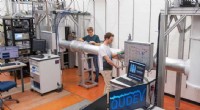
* Neglecting Air Resistance: In a vacuum, there is no air resistance to slow down the objects. Air resistance is what makes a feather fall slower than a rock in regular air.
The Experiment:
The famous experiment conducted by Apollo 15 astronaut David Scott on the Moon demonstrated this perfectly. He dropped a feather and a hammer at the same time. Since there is virtually no atmosphere on the Moon, both objects landed simultaneously.
In Conclusion:
While it may seem counterintuitive, the mass of an object does not affect how quickly it falls in a vacuum. The only factor that determines the time it takes to fall is the distance.