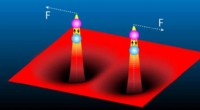
The law states that every particle of matter in the universe attracts every other particle with a force that is proportional to the product of their masses and inversely proportional to the square of the distance between them. This force is what causes objects to move in space.
The equation that describes the Law of Universal Gravitation is:
```
F = Gm1m2/r^2
```
where:
- F is the gravitational force
- G is the gravitational constant (6.674×10^-11 N·m^2/kg^2)
- m1 and m2 are the masses of the two objects
- r is the distance between the two objects
This law explains the motion of planets around the sun, the tides, and many other phenomena observed in the universe.