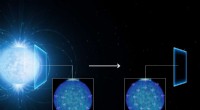
Quantum light sources emit photons in a quantum superposition, which is a fundamental property used in various quantum technologies such as quantum computing, cryptography, and communication. However, controlling these sources has proven to be a significant challenge.
The research team, led by Professor Philipp Strack, took inspiration from condensed matter physics and quantum field theory to overcome this hurdle. They incorporated the concept of a structured reservoir, known as an "engineered quantum reservoir," to realize quantum reservoir engineering.
The engineered quantum reservoir acts as an external environment that interacts with the light sources. By carefully tailoring the properties of this environment, the researchers could influence the quantum behavior of the light sources. This allowed them to control the emission of single photons from two independent quantum light sources simultaneously, which had never been achieved before.
"Quantum reservoir engineering offers a revolutionary approach to controlling quantum systems with great precision and efficiency," says Dr. Stephan Mohr from the Walter Schottky Institute. "This breakthrough holds immense potential for advancing quantum technologies and paves the way for novel applications in the field of quantum optics and quantum information processing."
The results represent an important milestone in the field of quantum physics, demonstrating the potential of quantum reservoir engineering for controlling multiple quantum systems. This opens up new avenues for research and development in quantum technologies, which are expected to revolutionize various fields from communication and computing to sensing and imaging.