This unexpected phenomenon, called second sound, is a thermal wave that travels at a surprising speed of 19 metres per second in superfluid helium. The sound waves, caused by thermal expansion, can be heard in the form of a faint hiss in a recording made by the researchers.
The research, published in the journal Nature Physics, was conducted by physicists at the University of Maryland and is a significant step forward in understanding the behaviour of superfluids and how they can move like waves.
"This is the first time anyone has been able to capture the sounds of heat moving in a superfluid, and it is a really beautiful phenomenon," said Matthew S. Turner, a PhD student in the Department of Physics and the University of Maryland's Joint Quantum Institute, who led the study.
"Superfluids are often described as being like 'quantum soup', so it was surprising and exciting to hear them sing."
For several decades, scientists knew that superfluids had two sound waves or excitations – the regular sound wave and second sound – but there had never been a way to hear them. This is because the frequency of the second sound was too high for human hearing to detect directly.
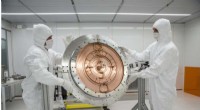
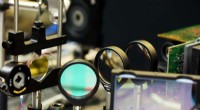
The researchers managed to overcome this challenge by using a special resonator to amplify the sound waves and transform them into lower-frequency pressure waves that could be captured with a sensitive microphone.
"The second sound waves were so weak that they were barely audible. But by amplifying them, we were able to hear them clearly," said Andrei Kapustin, professor of physics at the University of Maryland and the director of the Joint Quantum Institute.
"This breakthrough is very exciting, as it opens up new possibilities for studying the properties of superfluids and other quantum liquids."
The team of physicists, including Turner and Kapustin, are now planning to use the technique to investigate the behaviour of second sound in different types of materials and how it can be used to create new types of devices, such as ultra-sensitive sensors and quantum computers.
The research has been supported by the National Science Foundation, the Army Research Office, and the Alfred P. Sloan Foundation.