Summary:
Moiré superlattices, artificially engineered materials formed by stacking two or more layers of materials with a slight twist or misalignment, have emerged as a powerful platform for manipulating light and electrons in unprecedented ways. These designer materials exhibit remarkable electronic and optical properties that stem from the interplay of their moiré patterns, opening up new possibilities for advancing photonics and optoelectronics. This article explores the exceptional properties and promising applications of moiré superlattices in these fields.
Introduction:
Conventional semiconductor materials have served as the foundation of modern electronics and optoelectronics for decades. However, their performance and functionality are constrained by their intrinsic properties. Moiré superlattices, on the other hand, offer a new degree of freedom by introducing artificial periodicity and symmetry through the precise stacking of materials. By carefully engineering the moiré patterns, scientists can tailor the electronic band structure and optical response of these materials, leading to groundbreaking phenomena and devices.
Fundamentals of Moiré Superlattices:
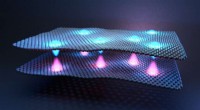
Moiré superlattices are created by stacking two materials with a slight twist or misalignment. This results in the formation of a periodic pattern of overlapping and interfering lattice structures, which gives rise to unique electronic and optical properties. The moiré pattern can be controlled by varying the twist angle, the number of layers, and the lattice mismatch between the materials.
Electronic Properties:
The moiré patterns in superlattices introduce new energy bands and modify the electronic density of states. This results in the emergence of correlated electronic states, such as flat bands and Dirac fermions, which exhibit exceptional transport and optical properties. These unique electronic properties have significant implications for realizing novel electronic devices, including high-temperature superconductors, high-mobility transistors, and quantum computing architectures.
Optical Properties:
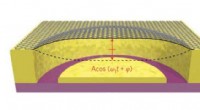
Moiré superlattices exhibit strong light-matter interactions due to the presence of moiré-induced potential landscapes. These potential landscapes can trap light and give rise to exciton polaritons, quasiparticles that result from the strong coupling between photons and excitons. Exciton polaritons in moiré superlattices exhibit long lifetimes, low effective mass, and strong nonlinear interactions, making them promising for applications in nanophotonics, polariton lasers, and nonlinear optics.
Applications in Photonics and Optoelectronics:
Moiré superlattices have sparked a surge of interest in various photonics and optoelectronics applications. These include:
1. Ultra-high-speed Photodetectors: Moiré superlattices can be used to design photodetectors with ultra-high sensitivity and speed due to their enhanced light absorption and fast carrier transport.
2. Polariton Lasers: The strong light-matter interactions in moiré superlattices enable the realization of polariton lasers, which operate based on exciton polaritons instead of free carriers. These lasers offer ultra-low thresholds, high efficiency, and tunable emission wavelengths.
3. Nonlinear Optics: Moiré superlattices exhibit enhanced nonlinear optical responses due to the confinement and interaction of light within the moiré potential landscapes. This enables efficient frequency conversion, parametric amplification, and ultrafast nonlinear switching.
4. Quantum Light Sources: Moiré superlattices provide a platform for generating entangled photons and single-photon emitters, which are essential components for quantum communication, quantum computing, and quantum sensing technologies.
Conclusion:
Moiré superlattices represent a powerful new paradigm in photonics and optoelectronics. By precisely engineering their moiré patterns, scientists can unlock extraordinary electronic and optical properties that transcend conventional materials. The unique properties of moiré superlattices pave the way for a wide range of next-generation devices, including ultra-high-speed detectors, polariton lasers, nonlinear optical elements, and quantum light sources. As research continues to delve into the full potential of these designer materials, moiré superlattices hold immense promise for revolutionizing future photonic and optoelectronic technologies.