Akinbostanci/Getty Images
When working with 3‑D solids, you often need to determine the area of a plane that slices through the shape—its boundaries are dictated by the solid’s geometry.
Consider a steel pipe buried beneath a residence: 20 m long and 0.15 m in diameter. You may wish to calculate its cross‑sectional area.
Cross‑sections are typically taken perpendicular to a solid’s principal axes. For a sphere, any plane intersecting the body yields a circular slice.
The resulting area depends on the solid’s geometry, the orientation of the cut relative to its symmetry axis, and the plane’s position.
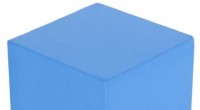
The volume of any rectangular solid—including a cube—is given by V = l × w × h.
If the cutting plane is parallel to the top or bottom face, the cross‑section is a rectangle with area l × w. When the plane is parallel to one of the side faces, the area becomes l × h or w × h. Non‑orthogonal cuts can produce triangles, hexagons, or other polygons depending on the plane’s angle.
Example: A cube has a volume of 27 m³. Because l = w = h, each edge is 3 m (since 3 × 3 × 3 = 27). A cross‑section perpendicular to a base is a 3 m × 3 m square, giving an area of 9 m².
A cylinder is formed by extending a circle along an axis perpendicular to its diameter. The base area is πr², where r is the radius.
If the cut is parallel to the cylinder’s axis, the cross‑section remains a circle with area πr². A slanted cut yields an ellipse, whose area is πab (with a the semi‑major axis and b the semi‑minor axis).
Example: The pipe under the home has a radius of 0.15 m. The cross‑sectional area is π(0.15)² ≈ 0.071 m². (Note that the pipe’s length does not affect this calculation.)
Any plane intersecting a sphere produces a circle. Knowing the circle’s diameter or circumference allows you to compute its area using C = 2πr and A = πr².
Example: A slice of Earth is cut near the North Pole, producing a circular section with a circumference of 10 m. The radius is r = 10/(2π) ≈ 1.59 m, yielding an area of π(1.59)² ≈ 7.96 m².