By Lee Morgan | Updated Mar 24, 2022
5bf5911a_905/iStock/GettyImages
Volcanoes are some of Earth's most powerful natural phenomena, serving as vents that release magma, ash, and gases from the planet's interior. Their behavior varies dramatically, influencing the surrounding landscape and communities.
Volcanoes differ in shape, eruption style, and lava type. The main categories—fissure, shield, stratovolcano, cinder cone, and caldera—each exhibit distinct characteristics and hazards.
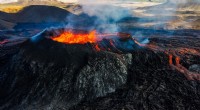
Fissure volcanoes, often called plateau basalts, erupt through elongated cracks rather than a central vent. These vents can span several miles and emit basaltic lava in relatively gentle, effusive flows. The resulting plains are typically flat, lacking a prominent summit. Iceland’s volcanic landscape is dominated by fissure eruptions, and a notable event occurred in 1952 in Nicaragua.
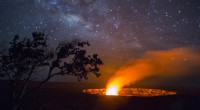
Shield volcanoes are broad, gently sloping mountains built from successive, low‑viscosity lava flows. They are renowned for their towering height and extensive bases—Mauna Loa, for instance, rises 30,000 ft above sea level and spans over 100 mi across. Although eruptions are usually less explosive, they can produce lava flows that travel many miles, slowly descending the volcano’s flanks. Kilauea, located adjacent to Mauna Loa, is the most active shield volcano worldwide and a major tourist attraction.
Stratovolcanoes, or composite volcanoes, combine layers of lava, ash, and pyroclastic material, giving them a steep, symmetrical cone. Their eruptions can be highly explosive, launching ash columns and pyroclastic flows that travel at high speeds. With heights up to 10,000 ft above sea level, they form some of Earth's most iconic peaks. Mount St. Helens (Washington), Mount Fuji (Japan), and the historic Vesuvius (Italy) are classic examples.
Cinder cones are the smallest volcano type, typically less than 1,000 ft tall. They form from the accumulation of ash, cinders, and volcanic bombs ejected during a single eruptive episode. The result is a circular or conical hill with a single summit crater. The cone at Crater Lake, Oregon, exemplifies this category.
A caldera forms when a volcano’s magma chamber empties catastrophically, causing the summit to collapse into the emptied space. These vast depressions can span several miles and may continue to erupt, often with significant explosivity. Notable calderas include Krakatoa, Santorini, and Yellowstone.