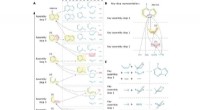
* Adenosine diphosphate (ADP): This is a molecule with two phosphate groups instead of the three in ATP.
* Inorganic phosphate (Pi): This is a free phosphate ion.
* Energy: This is released as heat or used to power cellular processes.
The reaction can be summarized as follows:
ATP + H₂O → ADP + Pi + Energy
Here's a breakdown:
* ATP (adenosine triphosphate) is a high-energy molecule that stores chemical energy in the bonds between its phosphate groups.
* H₂O (water) acts as a reactant, providing the necessary components for the reaction.
* ADP (adenosine diphosphate) is the product formed when one phosphate group is removed from ATP.
* Pi (inorganic phosphate) is the other product of the reaction.
* Energy is released as a result of the bond breaking, and it can be used to drive various cellular processes.
This hydrolysis of ATP is a fundamental reaction in cellular metabolism, providing the energy needed for various biological functions, including:
* Muscle contraction
* Active transport across cell membranes
* Synthesis of macromolecules (proteins, nucleic acids, etc.)
* Nerve impulse transmission
Essentially, ATP is like a "molecular currency" within cells, and its hydrolysis provides the energy for numerous essential activities.