However, a general representation can be written as:
E + S ⇌ ES ⇌ E + P
Where:
* E represents the enzyme
* S represents the substrate
* ES represents the enzyme-substrate complex
* P represents the product
Explanation:
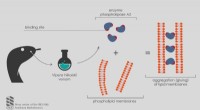
1. E + S ⇌ ES: The enzyme and substrate bind reversibly to form an enzyme-substrate complex.
2. ES ⇌ E + P: The enzyme-substrate complex transforms into an enzyme-product complex, which then releases the product, regenerating the free enzyme.
Important Notes:
* This equation represents a simplified model. The actual reaction mechanism can be much more complex, involving multiple steps and intermediates.
* The direction of the reaction (forward or reverse) depends on the relative concentrations of substrate, product, and enzyme, as well as other factors like temperature and pH.
* The specific enzyme involved determines the specific substrate and product involved in the reaction.
Examples:
* Lactase: Lactose (substrate) + H2O (water) → Glucose (product) + Galactose (product)
* Catalase: 2 H2O2 (substrate) → 2 H2O (product) + O2 (product)
In summary, while there's no single equation for all enzymatic reactions, the general representation above provides a helpful framework for understanding the basic steps involved. It emphasizes the importance of the enzyme-substrate complex in catalysis.