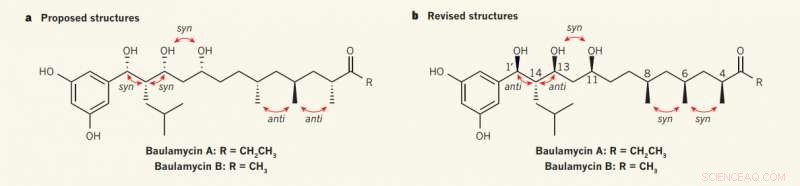
Previously proposed and actual molecular structures of the baulamycins. Credit: Nature (2017). doi:10.1038/nature23265
(Phys.org)—A team of chemists at the University of Bristol has correctly deduced the correct structure of the A and B baulamycins. In their paper published in the journal Nature, the team describes how they discovered that the baulamycins had been incorrectly structured and how they developed the new method for deducing the structure of flexible compounds in general. Severin Thompson and Thomas Hoye with the University of Minnesota offer a News & Views piece on the work done by the group in the same issue and explain how the new method could be used to help medical scientists identify natural compounds that might offer medical benefits.
Despite their seemingly simple nature, molecules do not always display their true structure—they actually show a number of unique conformations. This makes it difficult for chemists attempting to understand or recreate them. Especially difficult is getting a handle on the true structure of flexible compounds. In this new effort, the researchers describe their discovery that the structure of A and B baulamycins had been incorrectly described by previous researchers and their efforts to find its correct structure, which led them to develop a new procedure to deduce the structure of a wide variety of natural compounds.
A and B baulamycins are polyketide antibiotics with long, flexible carbon chains. Because of their benefits, researchers have tried to create synthetic versions of them, but until now, have failed. The reason appears to be earlier incorrect descriptions of their structure. After making that discovery, the researchers set about determining the true structure.
The new method developed by the team involves using both computational methods and nuclear magnetic resonance spectra of the original material to figure out which configurations the compounds naturally take. They then made mixtures of possible isomers of baulamycin A with unequal ratios to identify which of the compounds matched the compound in its natural state. Once they had the correct structure, the team synthesized the compound, which can be used as an antibiotic. The team suggests the same process could be used by other researchers to deduce the correct structure of other natural complex molecules.
© 2017 Phys.org