2KI (Potassium Iodide) + CuSO4 (Copper Sulphate) → CuI (Copper Iodide) + 2K2SO4 (Potassium Sulphate)
During the reaction, the potassium ions (K+) from KI combine with the sulphate ions (SO4^2-) from CuSO4 to form potassium sulphate (K2SO4). Simultaneously, the copper ions (Cu2+) from CuSO4 react with the iodide ions (I-) from KI to form copper iodide (CuI).
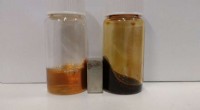
The products of the reaction, copper iodide (CuI) and potassium sulphate (K2SO4), are both insoluble in water. As a result, they form a precipitate that settles at the bottom of the container. The colour of the precipitate is pale yellow, which is characteristic of copper iodide. The remaining solution contains potassium sulphate, which is colourless and soluble in water.
In summary, when potassium iodide and copper sulphate are mixed, a chemical reaction occurs, resulting in the formation of copper iodide and potassium sulphate as insoluble precipitates.