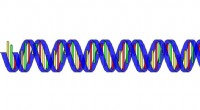
He and his colleague James Watson, working at the Cavendish Laboratory in Cambridge, used a model-building approach to determine the structure of DNA. They used metal rods and wooden balls to represent the different parts of the DNA molecule, such as the sugar-phosphate backbone and the nitrogenous bases. By manipulating these models, they were able to piece together the correct structure, which is now famously known as the double helix.