Credit: CC0 Public Domain
(Phys.org)—A small team of researchers with the University of Oldenburg has found that barn owls do not suffer hearing loss as they get older. In their paper published in Proceedings of the Royal Society B, the group describes hearing tests they conducted with a group of trained owls, what they found and why they believe more study of the birds may lead to preventing hearing loss in aging humans.
Most everyone knows that growing older can lead to hearing loss. It happens because humans and other mammals have an inability to regenerate sensitive cells inside the ear. As damage accumulates over time, hearing degrades. This is not the case with birds, however. Prior research has shown that some experience little if any hearing loss in their old age. In this new effort, the researchers looked to see if that also applied to long-lived birds such as the barn owl.
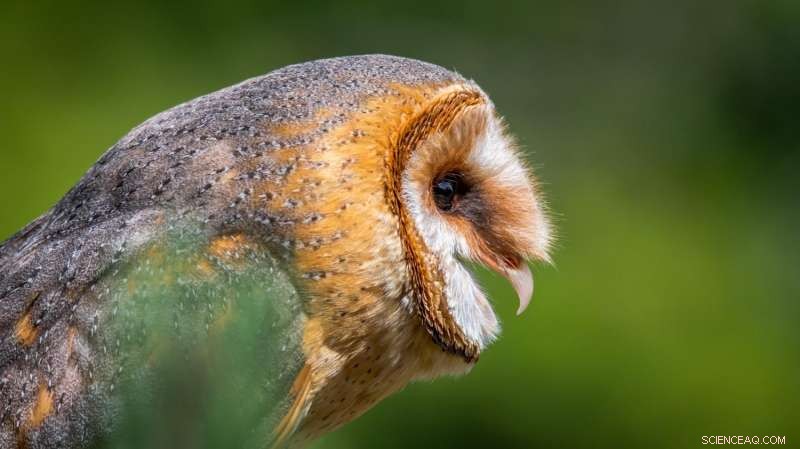
Barn owls are the most widespread of all the owls—they are found all around the world except in polar and desert regions. They earned their name by taking up residence in barns, drawn by the rodents that are attracted to stored grains. Barn owls have exceptionally good hearing—approximately 10 times as sensitive as human hearing, according to previous research. Barn owls are able to use hearing alone to capture prey moving in total darkness. They also live a long time—some in captivity have lived to be over 20 years of age.
To learn more about barn owl hearing during aging, the researchers trained seven owls (aged two to 17) to fly from one position to another to receive a treat in response to an auditory signal. The birds were then separated into age groups and the researchers tested their hearing by altering the tones. The researchers report no difference in hearing abilities between all of the birds. As an aside, the team also tested the hearing of another individual barn owl that had lived to be 23 years old, and found that its hearing was just as good as the younger owls.
The researchers conclude by asserting that barn owls do not experience hearing loss as they age and suggest that studying them and other birds to learn how they regenerate damaged nerves in their ears may lead to treatments for humans.
© 2017 Phys.org