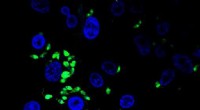
* Lack of a Nucleus: Prokaryotic cells do not have a membrane-bound nucleus to house their genetic material (DNA). Instead, their DNA is located in a region called the nucleoid, which is not enclosed by a membrane.
* No Membrane-Bound Organelles: Prokaryotic cells lack other membrane-bound organelles like mitochondria, Golgi apparatus, endoplasmic reticulum, lysosomes, etc. These organelles are responsible for specific functions in eukaryotic cells.
* Smaller Size: Prokaryotic cells are generally much smaller than eukaryotic cells.
* Simple Structure: The overall structure of prokaryotic cells is simpler compared to eukaryotic cells.
In contrast, eukaryotic cells have a nucleus and membrane-bound organelles, making them much more complex.