By Kevin Beck – Updated August 30, 2022
Neptune has long captivated astronomers as the farthest major planet from the Sun. Until 2006, it was the second‑most distant planet in the solar system, until Pluto’s reclassification as a dwarf planet left Neptune as the sole planet orbiting beyond 30 astronomical units (AU) from the Sun.
The Sun, our central star, dominates the solar system’s mass. From the innermost to the outermost, the eight recognized planets are Mercury, Venus, Earth, Mars, Jupiter, Saturn, Uranus, and Neptune. In addition to these, there are five dwarf planets, a handful of moons orbiting both planets and dwarf planets, roughly 780,000 asteroids between Mars and Jupiter, about 3,500 comets, and countless meteoroids.
The first four planets are terrestrial, composed primarily of rock and metal. The outer four—Jupiter, Saturn, Uranus, and Neptune—are gas giants, each possessing a dense core surrounded by thick atmospheres. Neptune, though the smallest of the gas giants, is still four times Earth’s diameter and far more massive than the terrestrial planets. Every gas giant has at least one ring system, with Saturn’s rings being the most iconic.
While the solar system spans tens of billions of kilometers, it is a mere speck within the Milky Way, a spiral galaxy that takes about 230 million years for the Sun to complete one orbit around its center.
Earth’s average distance from the Sun is about 93 million miles (1 AU). The planet’s orbit is elliptical, ranging from 91 million miles at perihelion to 95 million miles at aphelion. Expressing planetary distances in AU provides a clear sense of scale across the system.
Mercury lies at 0.39 AU, Venus at 0.72 AU, Earth at 1 AU, and Mars at 1.52 AU. The Asteroid Belt, separating the terrestrial planets from the gas giants, sits roughly 2.8 AU from the Sun. Jupiter’s orbit is 5.20 AU, Saturn’s 9.58 AU, Uranus’s 19.20 AU, and Neptune’s 30.05 AU.
Neptune’s 30‑AU orbit makes it 20.4 AU farther from the Sun than Uranus, underscoring its isolation in the outer solar system.
Neptune completes an orbit every 164.8 Earth years and is four times Earth’s diameter. It remains invisible to the naked eye from Earth, though skilled observers can spot it with binoculars. Although it was once thought to be the most distant planet, Pluto’s highly elliptical orbit brought it inside Neptune’s orbit between 1979 and 1999, relegating Neptune to the position of the outermost planet.
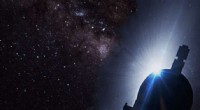
Because light travels at 186,000 miles per second, a solar photon takes about 15,000 seconds—over four hours—to reach Neptune’s surface. Remarkably, Voyager 2, launched in 1977, reached the planet in just over a decade, arriving in 1989.
The discovery of Neptune is a testament to scientific collaboration. French mathematician Urbain Le Verrier predicted a new planet based on perturbations in Uranus’s orbit and shared his calculations with German astronomer Johann Gottfried Galle, who confirmed the planet’s existence on the very first night of observation.
Voyager 2’s 1989 fly‑by delivered the first close‑up images and data of Neptune, unveiling six previously unknown moons and revealing that Triton, the largest moon, has active geology, including geysers and seasons. Triton’s retrograde orbit—moving opposite Neptune’s rotation—adds a unique dynamical intrigue.
The spacecraft also captured the “Great Dark Spot,” a storm with winds exceeding 1,000 miles per hour, the fastest recorded in the solar system. This phenomenon parallels Jupiter’s famous Great Red Spot.
For more in‑depth information, visit the NASA JPL Neptune Overview page.