Astrobobo/Getty Images
Mars has captivated observers for centuries, from early naked‑eye sightings to the first telescopic glimpses in the 17th century. While early telescopes offered only rudimentary views, astronomers like Huygens and Cassini gradually resolved more surface details. In the late 1800s, Italian astronomer Giovanni Schiaparelli reported observing extensive, straight “canals” on Mars—later mistranslated as “canals” in English—which sparked speculation about intelligent life and flowing water. Subsequent observations with larger apertures, however, failed to confirm these features, and the idea of surface water channels was largely abandoned by the mid‑20th century.
That perception changed dramatically when NASA’s Mariner 9 spacecraft orbited Mars in 1971, revealing valley networks and geological formations that closely resemble Earth’s river valleys and canyon systems. Mariner 9’s images provided the first concrete evidence that Mars once harbored a more complex, wetter climate than the present-day dusty environment suggests.
Because Mars lacks plate tectonics, its surface preserves a near‑complete record of the planet’s ancient environment, offering a unique window into its early climate. The earliest recognized era—the Noachian period, spanning roughly 4.0 to 3.5 billion years ago—features extensive valley networks that almost certainly formed under flowing liquid water. This evidence, combined with other geological markers, indicates that Mars once maintained an atmosphere capable of supporting liquid water.
Debate remains over the exact nature of this early climate. Some researchers argue that Mars was a cold world with limited equatorial water, while others propose a warmer, wetter environment that may have supported a northern‑hemisphere ocean. Ongoing studies continue to refine these models.
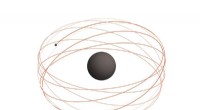
[Featured image by ESO/M. Kornmesser/N. Risinger (skysurvey.org) via Wikimedia Commons | Cropped, scaled, and mirrored | CC BY 4.0]
A pivotal event that set Mars on its trajectory toward the arid world it is today was the cooling of its metallic core, which extinguished its magnetosphere. Mars’ relatively small size and distance from the Sun meant it could not sustain the core convection necessary to generate a planetary magnetic field.
According to a 2021 study published in Science Advances, this loss occurred early in the Noachian period, yet its full impact unfolded over billions of years. A magnetosphere protects a planet’s atmosphere from solar wind erosion—as Earth’s field shields us from solar flares. Without it, Mars’ carbon dioxide envelope was stripped into space or sequestered as surface carbonate minerals.
The atmospheric loss caused a gradual decline in surface pressure and temperature. As temperatures fell, surface water froze; without atmospheric pressure, any remaining liquid water would have boiled or sublimated. These processes persist today, with Mars losing up to 3 kg of atmospheric mass per second.
The subsequent Hesperian epoch is marked by heightened volcanic activity and a reduction in meteorite impacts. Volcanism blanketed roughly 30% of the surface, while the emitted sulfur dioxide acidified remaining surface waters.
Despite a colder climate, evidence of flowing water remains. Much of the planet’s water was stored underground under immense pressure, but episodic releases produced cataclysmic outflows—estimated to be over 1,000 times the volume of the Mississippi River—that carved deep channels.
Whether these floods generated a transient Hesperian ocean that later froze remains contested. Some scientists argue the outflows could have formed a short‑lived ocean, while others contend the volume was insufficient to fill a global basin. A 2022 article in the Journal of Geophysical Research: Planets suggested tsunami‑like activity in such an ocean, though this hypothesis is still debated.
Today, Mars resides in the Amazonian period, a geologically quiescent era that has lasted nearly 3 billion years. The climate is dominated by pronounced temperature swings between summer and winter, driving three seasonal cycles.
The carbon dioxide cycle governs the sublimation and deposition of CO₂ ice at the polar caps, while the dust cycle modulates global temperatures by both absorbing daytime solar radiation and radiating heat at night. Dust‑laden winds further stir airborne particles, amplifying the dust cycle’s effects.
In terms of future exploration, the water cycle remains critical. Though Mars is arid, it harbors substantial ice—primarily underground and at the north pole. If this ice were uniformly melted, it could form an ocean 300 to 5,000 feet deep, potentially supporting sustained human activity.