By John Newton
Updated Aug 30, 2022
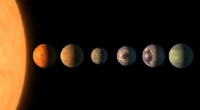
Our solar system resides in the Orion arm of the Milky Way and hosts eight confirmed planets orbiting the Sun. Though once considered the ninth planet, Pluto was reclassified as a dwarf planet in 2006 after NASA refined the definition of a planet.
Mercury is the closest planet to the Sun, completing an orbit in 88 Earth days and rotating on its axis every 59 days. The surface experiences extreme temperature swings—from scorching daytime highs to sub‑freezing nights—yet NASA scientists have identified ice deposits in permanently shadowed craters.
Venus rivals Earth in size and mass but possesses a thick, carbon‑dioxide‑rich atmosphere that creates a runaway greenhouse effect. The planet’s surface temperature exceeds 1,000 °F (about 600 °C), hot enough to melt lead, and it is marked by volcanic plains and a harsh, toxic environment.
Earth stands out as the only known planet that supports life, thanks to its breathable atmosphere, liquid water, and a moderate climate. Its distance from the Sun allows temperatures to remain neither too hot nor too cold, creating a dynamic environment where ecosystems thrive.
Known as the Red Planet, Mars has roughly half the diameter of Earth but the same amount of dry land. It features seasons, polar ice caps, colossal volcanoes, and canyons. Although its atmosphere is too thin to sustain liquid water on the surface, NASA rovers confirmed subsurface ice in 2004.
Jupiter, the largest planet in our solar system, is a gas giant composed mainly of hydrogen and helium. With dozens of moons, a powerful magnetic field, and swirling cloud bands, it resembles a miniature solar system. Its iconic Great Red Spot—a massive storm—has raged for centuries.
Saturn is the second‑largest planet and the least dense. Its iconic ring system consists of ice particles and is shared by all gas giants. Like Jupiter, Saturn has no solid surface and is dominated by hydrogen and helium. Its moon Titan is the only natural satellite in the solar system with a substantial atmosphere.
Uranus shines a blue‑green hue due to methane absorbing red light in its upper atmosphere. The planet’s axis is tipped nearly 90 degrees, likely the result of a massive collision with an Earth‑sized body during the early solar system.
Neptune, the most distant planet, is over 30 times farther from the Sun than Earth. It takes 165 Earth years to complete one orbit. The planet’s atmosphere is rich in methane, producing bright blue clouds that move at speeds approaching 700 mph (1,100 km/h). Eleven moons orbit Neptune, with Triton being the largest.