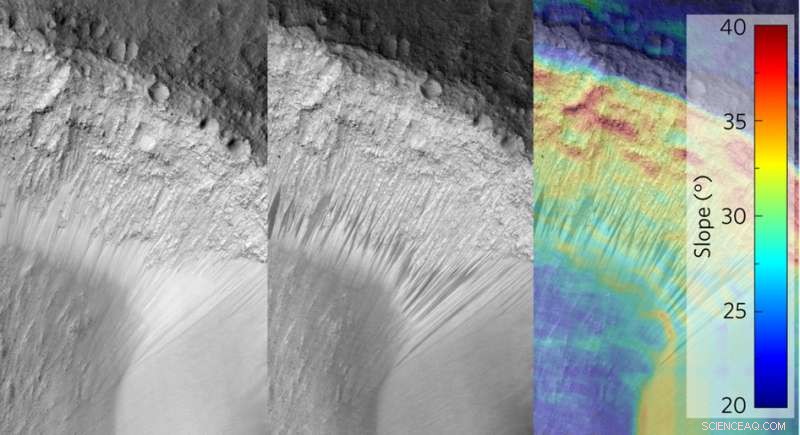
Evolution of RSL at Garni Crater, Valles Marineris, Mars. Credit: Nature Geoscience (2017). DOI: 10.1038/ngeo2917
(Phys.org)—A team of researchers from France and the Slovak Republic has proposed a theory to explain the water-like streaks that appear seasonally on the surface of Mars, which do not involve water. In their paper published in the journal Nature Geoscience, the team describes their theory as instances of sand avalanches caused by sunlight with resulting changes to shadowing.
Back in 2011, finger-like marks were first noted on the surface of Mars. After study, it was determined that the streaks changed in a way that appeared to resemble flowing water and that the changes were seasonal—occurring during times when it was hottest. Some scientists suggested that there might be a type of brine just beneath the surface causing the streaks as a result of melting ice, but other studies have suggested the water theory is unlikely because if ice were there, it would likely sublimate rather than melt and evaporate. In this new effort, the researchers suggest the streaks have nothing to do with ice or water but are instead more of an optical illusion.
The researchers suggest the streaks come about due to the heat that is generated during certain times of the year on Mars—it causes the top layer of dirt and sand to heat up while particles underneath remain cool. The difference in temperature causes changes in pressure to very small pockets of gas trapped between the sand particles causing the gas to move upwards. Doing so jostles the sand particles, causing them to slip downhill slightly—like tiny avalanches. The result is recurring slope lineae that originate only on sloping, rocky landscapes. The difference in color is due to the newly fallen particles as they move under shadows cast by boulders or outcrops, mostly during the afternoon as the angle of sunlight would be more pronounced.
More testing will have to be done, of course, before the theory can be proved true, but if it turns out to be the correct explanation, it is likely some in the space field might be disappointed—water just under the surface might have led to the discovery of a form of life, and it might also have proved useful to future astronauts trying to survive on the barren planet.
© 2017 Phys.org