Tolkung/Shutterstock
The auroras—the northern and southern lights—are arguably the most stunning celestial displays on Earth. When you’re in the right place at the right time, the sky above you becomes a dynamic canvas of glowing curtains that shift and shimmer in vivid hues.
On a typical evening, the dominant color is a soft green, but under the right conditions you may also see reds, blues, purples, yellows, or even pinks. Each shade tells a story about the particles and gases that create it.
To appreciate why auroras come in different colors, it helps to understand their origin. The sun continuously emits a high‑energy stream of particles—mostly hydrogen and helium nuclei stripped of electrons—known as the solar wind. While most of this stream is deflected by Earth’s magnetosphere, a portion is funneled toward the poles, where it collides with the upper atmosphere and sets the stage for the auroral glow.
Juan Maria Coy Vergara/Getty Images
Green is the most common auroral hue because human vision is especially sensitive to it in low‑light conditions. The light comes from excited atomic oxygen, not the oxygen we breathe. When high‑energy particles bump into atmospheric oxygen, they lift its electrons to higher energy levels. The excited atom then emits a green photon as it relaxes.
Unlike gases such as sodium or neon, which return to ground state almost instantly, atomic oxygen takes roughly three‑quarters of a second to de‑excite. In denser, lower layers of the atmosphere, collisions with other particles can quench this process before the atom has a chance to glow, limiting green emission to altitudes around 60 miles and higher.
David Mcnew/Getty Images
Red auroras arise both above and below the familiar green bands, each with a distinct source. Above 150 miles, oxygen again drives the red glow. At these higher altitudes, collisions are rarer, allowing excited atoms to hold onto their energy longer. After a brief pause, they release a red photon before finally returning to the ground state.
Below the green bands, the red fringe comes from molecular nitrogen, producing a slightly violet‑red tone. This lower‑altitude red is rare because only the most energetic solar particles can penetrate below 60 miles, where nitrogen dominates.
During powerful solar storms, intense bursts of particles—such as coronal mass ejections—can ignite red auroras far outside the polar regions. When a flood of high‑energy particles strikes oxygen around 200 miles up, the resulting glow is bright enough to be visible over a wide area.
Arctic-images/Getty Images
Blue or purple hues are produced by ionised molecular nitrogen, which glows around 60 miles during periods of strong solar activity. When ionised and neutral nitrogen coexist, their emissions can blend, creating colors ranging from magenta to deep blue.
Higher in the atmosphere (above 180 miles), hydrogen and helium can emit faint blue or purple light, though this is only detectable under exceptionally dark skies and intense solar input.
Yellow auroras result from a mixture of the green oxygen emission and the red glow of non‑ionised nitrogen. This combination is uncommon because it requires both low‑altitude nitrogen excitation and the presence of oxygen at a slightly higher altitude.
Nasa/Getty Images
Earth isn’t the only planet that hosts auroras. Every planet with an atmosphere except Mercury shows auroral activity, though the appearance varies. Venus and Mars, lacking strong magnetic fields, experience auroras wherever solar particles reach their thin atmospheres.
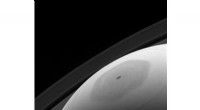
The gas giants emit ultraviolet auroras, with Jupiter’s bursts intense enough to produce X‑rays. Saturn’s auroras include visible light that would appear red to an observer on board a spacecraft, while Uranus displays infrared auroras and Neptune’s glow is observed in radio waves.
Several moons also exhibit auroral phenomena. Jupiter’s Galilean moons show visible auroras dominated by red oxygen light, with Io adding orange sodium emission. Neptune’s moon Triton may host auroras, but its great distance limits detailed observations.