Dottedhippo/Getty Images
There are over 1.4 million asteroids in our solar system, most residing in the asteroid belt between Mars and Jupiter. Their sizes range from a few feet to 329 miles in diameter. Anything larger than 460 feet and within roughly 4.68 million miles of Earth is classified as potentially hazardous. For this reason, asteroid 99942 Apophis—about 1,100 feet across—captured widespread attention after crossing NASA’s radar in 2004.
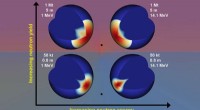
During its 2029 flyby on April 13, Apophis will pass within 24,000 miles of Earth’s surface, a distance that will put it in the naked‑eye view. This proximity is closer than the nearest approaches of the Great Comet, temporary second moons, the Moon itself, and even our most distant communication satellites. A study published in the Planetary Science Journal used simulated models to show that such a close pass will subject Apophis to significant tidal forces, likely triggering landslides and quakes that could alter its shape. Earth's gravity may also change its rotation and widen its orbit, moving it from the Aten to the Apollo group of asteroids.
Nazarii_Neshcherenskyi/Shutterstock
When Apophis was first discovered, scientists initially feared a potential Earth impact in 2029. However, a refined analysis by the Jet Propulsion Laboratory’s Center for Near‑Earth Object Studies in 2021 ruled out a collision for at least the next century. Through a partnership with NASA’s Planetary Defense Coordination Office, agencies continue to monitor the asteroid to enhance future impact mitigation strategies. The European Space Agency (ESA) is also involved.
ESA’s Rapid Apophis Mission for Space Safety (Ramses) plans to launch a spacecraft in April 2028, aiming to rendezvous with Apophis in February 2029. The mission will conduct a comprehensive survey of the asteroid’s orbit, orientation, rotation, shape, and surface. Scientists will also investigate its cohesion, composition, density, interior structure, mass, and porosity. Meanwhile, NASA has repurposed its OSIRIS‑REx spacecraft—now named OSIRIS‑APEX—to rendezvous one month after the flyby, enabling study of the gravitational aftermath. Having two spacecraft observing Apophis will allow long‑term monitoring and in‑depth analysis in the months following the encounter.