In November 2022, a research team at the University of Amsterdam achieved a landmark experiment: they recreated the event horizon of a black hole in a controlled laboratory setting and detected a faint glow reminiscent of Hawking radiation. The study, published in Physical Review Research under the title “Thermalization by a synthetic horizon,” demonstrates that the exotic physics of a cosmic event horizon can be simulated on Earth.
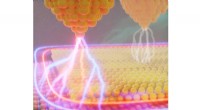
Lead researcher Lotte Mertens and colleagues arranged a single‑file chain of atoms, finely tuning the electron‑hopping probability between them. By adjusting this tunneling rate, they created a sharp transition in the chain that acts like an event horizon—a boundary beyond which excitations cannot escape. When a segment of the chain was moved across this boundary, the team observed a measurable temperature spike and, notably, a subtle increase in emitted radiation.
Stephen Hawking’s 1974 prediction of particle emission at a black‑hole horizon—now called Hawking radiation—arises from quantum field fluctuations near the event horizon. In the Amsterdam experiment, the synthetic horizon produced a glow that mirrors the thermal radiation expected from a true black hole, providing tangible evidence for Hawking’s theory in a tabletop setting.
Black holes sit at the intersection of Einstein’s general relativity and quantum mechanics. Observing Hawking‑like radiation in a laboratory bridges the gap between these two pillars, offering a new avenue to test quantum gravity concepts and search for a unified theory of everything.
While the nearest known black hole, Gaia BH1, lies some 1,500 light‑years away, and the first ever image of a black hole was only captured in 2019, this experiment shows that we can study event‑horizon physics without venturing into deep space. It opens the door to further experimental tests of some of the universe’s most profound mysteries.
Photo credit: Valentina Kalashnikova/Shutterstock; Image credit: Nazarii Neshcherenskyi/Shutterstock