In recent years, science has delivered startling revelations—from misidentified shipwrecks to new insights into the origins of life. Yet one of the most exciting discoveries comes not from a lab, but from the hands of an everyday prospector.
In 2015, David Hole, a seasoned gold prospector, found a dense, reddish stone while exploring Maryborough Regional Park near Melbourne—a region famed for its 150‑year gold‑mining heritage. Expecting a nugget of gold, he attempted to split the 37‑pound rock with every tool at his disposal: rock saws, angle grinders, drills, and even a sledgehammer. When these efforts failed, he turned to acid, only to find the stone equally impervious.
Suspecting something extraordinary, Hole brought the specimen to the Melbourne Museum, where geologists Dermot Henry and Bill Birch conducted a detailed examination. Using a diamond saw, they sliced the rock open, revealing a treasure of iron and nickel dense enough to explain its hefty weight. They identified the specimen as an H5 chondrite—a common yet scientifically valuable type of meteorite.
Chondrites are ancient clumps of silicate and metal that formed in the protoplanetary disk before the Sun and planets coalesced. The Maryborough meteorite carries intact droplets of silicate minerals, essentially snapshots of the gas cloud that birthed our solar system 4.6 billion years ago.
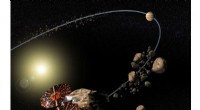
How did this extraterrestrial rock end up in an Australian field? Experts surmise that a collision in the asteroid belt between Mars and Jupiter ejected a fragment, which eventually fell to Earth. Radiocarbon dating suggests the meteorite reached the planet within the last millennium, making it one of the youngest terrestrial meteorites in Victoria.
Henry, Birch, and colleague Andrew Tomkins published their findings in a 2019 paper in the Proceedings of the Royal Society of Victoria, noting the Maryborough meteorite as the second‑largest single chondritic mass ever recovered in the state.
While many ordinary people stumble upon valuable artifacts—such as a 2019 gold pendant commemorating Henry VIII or a 2024 haul of 17 historic coins—this discovery stands out for its dual value: a priceless scientific record and a remarkable terrestrial find.