1. The Great Red Spot: This is the most famous feature of Jupiter, a gigantic storm that has been raging for centuries. It is a massive anticyclonic storm, meaning it rotates counter-clockwise. The spot is so large it could fit 2-3 Earths within its boundaries.
2. The Jovian Atmosphere: Jupiter's atmosphere is composed primarily of hydrogen and helium, with traces of other gases like methane and ammonia. The atmosphere is characterized by swirling clouds and bands of various colors, creating a stunning and constantly changing visual spectacle.
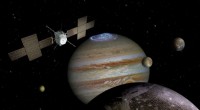
3. The Galilean Moons: These are four large moons that orbit Jupiter: Io, Europa, Ganymede, and Callisto. They are all incredibly diverse and fascinating in their own right.
* Io: It is the most volcanically active body in the Solar System.
* Europa: It harbors a vast subsurface ocean, making it a potential habitat for extraterrestrial life.
* Ganymede: It is the largest moon in the Solar System and has its own magnetic field.
* Callisto: It is heavily cratered and is thought to have a vast subsurface ocean.
4. The Rings of Jupiter: While less prominent than Saturn's rings, Jupiter also has a system of faint rings made up of dust and debris.
5. Auroras: Like Earth, Jupiter experiences auroras at its poles, caused by charged particles from the Sun interacting with its magnetic field.
In addition to these major landmarks:
* Jupiter's atmosphere shows complex patterns of swirling clouds and storms, including the South Equatorial Belt (SEB), the North Equatorial Belt (NEB), and the Great Red Spot's surrounding cloud bands.
* The planet also has an immense magnetic field, thousands of times stronger than Earth's, creating a vast magnetosphere that traps charged particles.
While not traditional landmarks in the same way as those found on Earth, these features are all incredible examples of Jupiter's dynamic and unique nature.