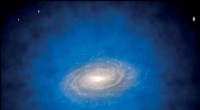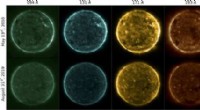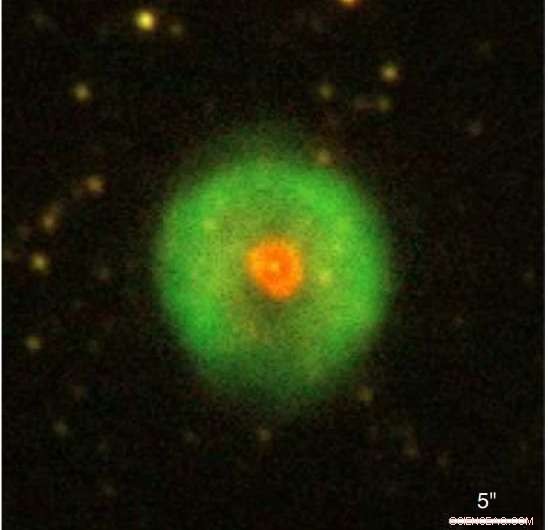
NOT ALFOSC [N ii] λ6584 (red) and Hαλ6563 (green) colour composite picture of HuBi 1. Credit: Nature Astronomy (2018). DOI: 10.1038/s41550-018-0551-8
An international team of researchers has discovered what they describe as an inside-out planetary nebula—a planetary nebula with surroundings that are the opposite of what normally occurs. In their paper published in the journal Nature Astronomy, the group describes their find and offer possible explanations for its existence.
The researchers note that normally, stars on the smaller side, like the sun, tend to eject a mixture of gas and dust when they get old. This material forms a cloud of electrically charged material. Such cloud-shrouded stars are known as planetary nebula. The researchers note that nebula clouds usually have a layered form—the closest layer is generally made up of heavily ionized helium; the next closest contains less-ionized oxygen, and the outermost region is usually made up of a mix of barely ionized oxygen and nitrogen. But now, the team has found something different—a nebula with a cloud of gas and dust that is the opposite of the norm. The gas in the outermost layer is more heavily ionized than that closest to the star—it is inside out.
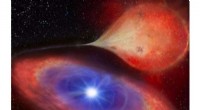
The researchers note that prior to their finding, it was believed that such nebula did not exist—there would be no way for them to form. But now that they have found one, they have come up with a possible explanation. They believe it is possible that as the star aged, shrinking down to a white dwarf, it had a last gasp of sorts—an explosion that sent a shock wave through the cloud, ionizing the gasses in the outermost region. The shock wave would have had to cool though, before it could ionize the gases it encountered, which explains why those in the inner layers were not more impacted. The team also reports that they went back and looked at historical records of the star and found that it had dimmed considerably over the past 46 years. They suggest this might be evidence of the nebula existing in the middle of the period when its constituent gases were still reacting to the rapid dimming of the star. They note that if their theory is correct, astronomers should see the star become less obscured in the coming years as the dust disperses.
© 2018 Phys.org