Gravity's Role:
* The Sun's Dominance: The Sun, being the most massive object in our solar system, exerts the strongest gravitational pull. This force holds all the planets, dwarf planets, asteroids, and comets in orbit around it.
* Orbital Paths: Gravity determines the shape and path of these orbits. The planets don't travel in perfect circles but rather in ellipses (slightly oval-shaped paths).
* Speed and Distance: Gravity dictates the speed at which objects move in their orbits. The closer a planet is to the Sun, the stronger the gravitational pull, and the faster it moves. Conversely, the farther away a planet is, the weaker the pull, and the slower it moves.
* Stability: Gravity keeps the solar system stable, preventing planets from flying off into space or colliding with each other.
Motion of the Solar System:
* Revolution: All planets, asteroids, and comets revolve around the Sun in elliptical orbits. The time it takes for an object to complete one revolution is its orbital period.
* Rotation: Planets also rotate on their axes, creating day and night cycles.
* Perturbations: The gravitational influence of other planets, especially the giant gas planets Jupiter and Saturn, cause slight deviations in the orbits of smaller planets. These gravitational tugs, while small, can be measured and affect orbital periods over long periods.
Other Factors:
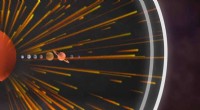
* Solar Wind: The Sun emits a constant stream of charged particles called the solar wind. This can have subtle effects on the orbits of objects in the solar system, especially those with weak gravitational fields, like comets.
* Interstellar Gravity: While much weaker, the gravitational pull of other stars in the Milky Way galaxy also contributes to the motion of the solar system as a whole.
In Summary:
Gravity is the primary force shaping the motion of our solar system. It determines the orbits of planets, their speeds, and the stability of the entire system. However, other factors like solar wind and interstellar gravity also play small roles, making the relationship between gravity and motion a complex and fascinating interplay of forces.