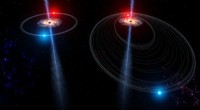
* Gravity's Influence: The primary reason for stellar motion is gravity. Stars are constantly tugging on each other, creating a complex dance of movement. Larger, more massive stars exert a stronger gravitational pull.
* Galaxy Rotation: Our Milky Way galaxy, like most spiral galaxies, rotates. This rotation causes stars to move in a general pattern around the galactic center.
* Random Motion: Stars also have random motion, called "peculiar velocity," that arises from interactions with other stars, gas clouds, and gravitational fluctuations. This random motion adds to the overall complexity of stellar movement.
* Stellar Evolution: As stars age, they change in mass, size, and luminosity. These changes can affect their gravitational influence and lead to shifts in their movement.
How We Observe Stellar Motion:
* Proper Motion: We observe the slight change in the apparent position of stars against the backdrop of distant stars over very long periods (years to decades).
* Radial Velocity: We use spectroscopy to measure the Doppler shift of starlight, revealing whether a star is moving towards or away from us.
The Big Picture:
The motion of stars is incredibly complex and fascinating. While individual stars might appear relatively static from our perspective, they are constantly in motion, participating in a grand cosmic dance. This movement plays a crucial role in the evolution of galaxies and the formation of new stars.