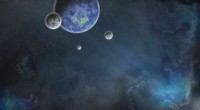
* Orbits a planet: Ganymede orbits Jupiter, which is a planet. This is the key factor in its classification.
* Not a planet itself: Ganymede does not orbit the Sun directly, which is a requirement for being classified as a planet.
While Ganymede is larger than the planet Mercury, its orbital status determines its classification.
Here's a breakdown of the current definitions used by the International Astronomical Union (IAU) for planets and moons:
* Planet: A celestial body that:
* Is in orbit around the Sun.
* Has sufficient mass for its self-gravity to overcome rigid body forces so that it assumes a hydrostatic equilibrium (nearly round) shape.
* Has cleared the neighborhood around its orbit.
* Moon (or satellite): A celestial body that orbits a planet or dwarf planet.
Therefore, Ganymede meets the criteria for a moon, but not for a planet.