Here's how it worked:
1. Nebula Formation: A nebula is a giant cloud of gas and dust, mostly hydrogen and helium.
2. Gravitational Collapse: Small variations in density within the nebula led to regions with slightly more mass. These regions exerted a stronger gravitational pull, attracting more gas and dust.
3. Accretion: As more matter was pulled in, the gravitational pull became even stronger, causing the cloud to collapse further and spin faster.
4. Protostar Formation: At the center of the collapsing nebula, the temperature and pressure increased tremendously, creating a protostar.
5. Nuclear Fusion: When the protostar reached a critical mass and temperature, nuclear fusion began in its core, releasing enormous energy and forming the Sun.
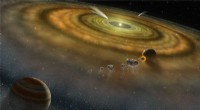
6. Planetary Formation: The remaining material in the swirling disk around the young Sun began to clump together under gravity. These clumps continued to accrete material, eventually forming planets, moons, asteroids, and other objects in the solar system.
In essence, gravity acted as the primary force, pulling matter together and driving the entire process of star and planet formation.