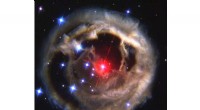
1. The Red Giant Phase:
* Fuel Shift: The Sun, currently fusing hydrogen into helium in its core, will start fusing helium into carbon. This process generates less energy, causing the Sun to expand dramatically.
* Size: The Sun will swell to become a red giant, engulfing Mercury, Venus, and likely Earth. Its outer layers will extend well past Earth's current orbit.
* Color: The Sun will turn a reddish orange due to its cooler surface temperature.
2. The Helium Flash:
* Core Instability: As the Sun's core becomes mostly helium, it will become extremely dense and hot.
* Sudden Fusion: The helium will suddenly start fusing into carbon in a runaway reaction called the "helium flash." This is a brief, intense burst of energy, but it doesn't significantly affect the Sun's overall evolution.
3. The Asymptotic Giant Branch (AGB) Phase:
* Further Expansion: The Sun will continue to expand, becoming even larger and cooler.
* Shell Burning: It will fuse helium into carbon in a shell around its core, while also fusing hydrogen into helium in a shell further out. This creates a complex internal structure.
* Mass Loss: The Sun will lose significant mass through stellar winds, expelling material into space.
4. The Planetary Nebula:
* Final Collapse: Once the Sun's core is mostly carbon and oxygen, it will be unable to fuse heavier elements. The outer layers will be ejected into space, forming a beautiful, colorful cloud called a planetary nebula.
* Size: The ejected material will expand and dissipate over time, leaving behind a small, dense core.
* Color: The planetary nebula will exhibit various colors depending on the composition of the ejected gas.
5. The White Dwarf:
* The Remnant: The core that remains after the planetary nebula is called a white dwarf. It's extremely dense, packed with the mass of the Sun into the size of Earth.
* Color: White dwarfs start out hot and white, but they gradually cool down over billions of years, eventually becoming black dwarfs.
Key Points:
* Our Sun's life cycle is typical for stars like it (called "main-sequence" stars).
* The red giant phase is the most dramatic and will have a significant impact on our solar system.
* While the Sun won't become a supernova (like larger stars), its final fate is to become a white dwarf.
Let me know if you'd like to explore any of these phases in more detail!