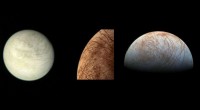
Here's why:
* Low gravity: Moons have much weaker gravity than planets. This makes it difficult to hold onto an atmosphere, as gas molecules easily escape into space.
* Small size: Smaller objects have a lower escape velocity, making it even easier for gases to escape.
* Distance from the Sun: Moons are further from the Sun than planets, meaning they receive less solar radiation, which is necessary to heat up and energize the atmosphere.
Exceptions:
* Titan (Saturn's moon): Titan has a dense atmosphere, primarily composed of nitrogen, that is even thicker than Earth's. It's the only moon with a substantial atmosphere.
* Ganymede (Jupiter's moon): Ganymede has a very thin atmosphere, mostly made up of oxygen.
* Triton (Neptune's moon): Triton also has a thin atmosphere, primarily nitrogen.
However, even these exceptions have much thinner atmospheres than Earth. So, in general, moons are mostly airless bodies.