Direct Imaging:
* Challenges: Directly imaging planets is extremely difficult because they are incredibly faint compared to their host star. The star's light overwhelms the planet's signal.
* Techniques:
* Adaptive Optics: This technology helps to remove the blurring effects of Earth's atmosphere, allowing for sharper images.
* Coronagraphy: This technique blocks out the starlight, making it easier to see faint planets.
* Space Telescopes: Observing from space eliminates the distortions caused by Earth's atmosphere, making direct imaging more successful.
* Near-infrared: Planets emit infrared radiation, and observing in this wavelength helps differentiate them from the star.
Indirect Detection:
* Radial Velocity (Doppler) Method:
* Principle: This method detects the "wobble" of a star caused by the gravitational pull of an orbiting planet. The star's light spectrum shifts slightly back and forth, revealing the planet's presence.
* Strengths: Very effective for detecting massive planets close to their star.
* Limitations: Less sensitive to smaller planets or planets far from the star.
* Transit Method:
* Principle: This method detects a slight dip in the star's brightness when a planet passes in front of it (transits).
* Strengths: Highly successful in finding planets of various sizes, including Earth-sized planets.
* Limitations: Only works for planets that orbit their star from a specific angle where we can observe a transit.
* Microlensing:
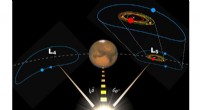
* Principle: This method utilizes the bending of light by the gravitational field of a star and planet as they pass in front of another star.
* Strengths: Can detect planets far from their host star, even in other galaxies.
* Limitations: This is a rare event, and observations are limited.
* Astrometry:
* Principle: Measures the tiny wobble of a star caused by the gravitational pull of an orbiting planet, similar to radial velocity, but by looking at the star's position in the sky rather than its spectrum.
* Strengths: Can detect planets farther out from the star than radial velocity.
* Limitations: Requires precise measurements and long-term observations.
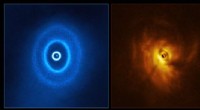
* Disk Substructures:
* Principle: Observing the gaps, rings, and other structures within the protoplanetary disk around a young star can indicate where planets are forming.
* Strengths: Can help understand the early stages of planet formation.
* Limitations: Doesn't directly detect the planets themselves.
Future Technologies:
* Next-generation telescopes: Larger and more powerful telescopes, such as the James Webb Space Telescope, will greatly enhance our ability to directly image exoplanets.
* Space-based interferometry: Combining the light from multiple telescopes in space will allow for even sharper images.
In summary:
Detecting planets forming around stars is a multifaceted task. Each method has its own strengths and weaknesses, and researchers often combine multiple approaches to confirm the presence of a planet and learn more about its properties. This exciting field continues to evolve with advancements in technology and observational techniques, leading to the discovery of new worlds and expanding our understanding of planet formation.