1. The Birth of a Star:
* Gravitational Collapse: The solar nebula, composed mainly of hydrogen and helium, began to collapse under its own gravity.
* Rotation and Flattening: As the cloud collapsed, it also began to rotate faster, much like a figure skater pulling in their arms. This rotation caused the nebula to flatten into a disk shape.
* Protostar Formation: At the center of the disk, the densest part of the cloud collapsed into a hot, dense protostar. This protostar eventually became our Sun.
2. Formation of Planets:
* Dust Grains and Planetesimals: Within the disk, dust grains began to clump together, forming larger particles called planetesimals.
* Accretion: These planetesimals continued to collide and stick together through a process called accretion, gradually growing into larger bodies.
* Planetary Differentiation: As the planets grew larger, their internal temperatures increased due to the heat of accretion. This led to planetary differentiation, where heavier elements sank to the core and lighter elements rose to the surface.
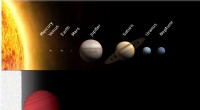
* Gas Giant Formation: In the outer, colder regions of the disk, where ice could form, larger planetesimals grew rapidly, accreting gas from the surrounding nebula. This resulted in the formation of the gas giants (Jupiter, Saturn, Uranus, and Neptune).
* Terrestrial Planet Formation: In the inner, warmer regions of the disk, where ice could not form, planetesimals primarily accreted rocky and metallic material, leading to the formation of the terrestrial planets (Mercury, Venus, Earth, and Mars).
3. The Aftermath:
* Clearing the Disk: The young Sun's powerful solar wind eventually cleared away the remaining gas and dust from the disk, leaving behind the planets we see today.
* Late Heavy Bombardment: In the early stages of the solar system, a period of intense bombardment by asteroids and comets, known as the Late Heavy Bombardment, occurred, significantly reshaping the planets.
4. Ongoing Evolution:
* Evolution of Life: On Earth, the conditions became favorable for the emergence and evolution of life.
* Continued Change: The planets continue to evolve, influenced by factors such as volcanic activity, impacts, and the Sun's energy output.
Key Factors Contributing to the Formation:
* Gravity: The fundamental force driving the collapse of the solar nebula and the accretion of planetesimals.
* Rotation: The rotation of the nebula led to its flattening into a disk, providing the building blocks for planet formation.
* Temperature: The temperature gradient within the disk determined the composition of the planets.
* Time: The formation of the solar system took billions of years, allowing for complex processes to occur.
Understanding the formation of our solar system provides insights into the processes that may have led to the formation of other planetary systems throughout the universe.