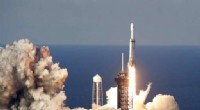
1. Thrust Generation: Rockets generate thrust by expelling high-velocity gases from their nozzles. This expulsion creates an action-reaction force, pushing the rocket in the opposite direction according to Newton's Third Law of Motion.
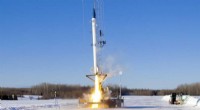
2. Overcoming Gravity: The initial stage of a rocket launch involves generating enough thrust to overcome the pull of gravity. The rocket's powerful engines ignite and produce an immense amount of thrust, propelling it upwards.
3. Staging: Rockets often use multiple stages, each with its own set of engines. As the lower-stage engines burn out and become empty, they are discarded, reducing the overall weight and increasing efficiency. This allows the rocket to continue with reduced weight and fuel requirements.
4. Transition to Orbital Motion: After the rocket has overcome gravity, it must then achieve orbital velocity to stay in space. Orbital velocity is the speed required for an object to maintain a stable orbit around a larger body, such as Earth. Rockets achieve this velocity through a combination of thrust, gravity assist, and trajectory adjustments.
Now, let's consider how satellites stay in orbit:
1. Orbital Mechanics: Satellites remain in orbit due to the principles of orbital mechanics. An object in orbit is continuously falling towards the primary body (in this case, Earth), but its forward momentum keeps it in a perpetual state of free fall around the planet.
2. Balance of Forces: Satellites maintain a balance between gravity and centrifugal force. Gravity pulls the satellite towards Earth, while the satellite's orbital velocity causes it to move outward. These opposing forces result in a stable elliptical or circular orbit.
3. Centrifugal Force: As a satellite moves in orbit, its linear motion creates centrifugal force that counteracts the pull of gravity. This centrifugal force prevents the satellite from spiraling directly into Earth.
4. Perturbations: Real-world orbits are not perfectly stable due to various external influences, such as atmospheric drag and gravitational anomalies. Satellites require occasional adjustments to their orbits, known as orbital maneuvers, to correct their trajectories and maintain the desired orbital parameters.
In summary, rockets achieve lift-off by generating powerful thrust to overcome gravity, while satellites remain in orbit due to orbital mechanics, balancing the forces of gravity and centrifugal force. Advanced propulsion systems and precise orbital calculations enable space vehicles to reach their destinations and maintain their positions in orbit.