1. Dark Matter Halo: Galaxies are surrounded by a halo of dark matter, a mysterious and invisible form of matter that makes up a large portion of the universe's mass. Dark matter extends well beyond the visible boundaries of galaxies and plays a crucial role in shaping their structure and dynamics.
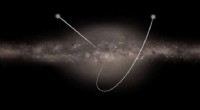
2. Galactic Disk and Bulge: The visible parts of galaxies, such as stars and gas, are concentrated in a flattened disk and a central bulge. However, beyond the main luminous components, there are often extended stellar populations in the outer regions, including stellar streams or faint stellar halos.
3. Intergalactic Space: The space between galaxies is called intergalactic space. It is not entirely empty but contains diffuse gas, dust, and remnants from past events, such as supernova explosions. Intergalactic space also hosts a complex network of cosmic filaments, which are huge structures of gas that connect galaxies and play a role in galaxy formation.
4. Galaxy Clusters and Superclusters: Beyond individual galaxies, larger-scale structures emerge, such as galaxy groups, clusters, and superclusters. These hierarchical organizations of galaxies can span millions of light-years and can contain hundreds to thousands of individual galaxies bound by gravity.
5. Galactic Interactions: At the outskirts of galaxies, particularly in crowded regions, interactions with neighboring galaxies can occur. These interactions can trigger processes such as starbursts, galaxy mergers, and tidal disruptions, which shape the appearance and evolution of galaxies over time.
6. Cosmic Expansion: The entire universe is expanding, and this expansion affects the distance and distribution of galaxies. As we observe galaxies farther from our own, we see them moving away from us due to the expansion of space, which influences their observed properties and distance measurements.
7. Cosmic Microwave Background (CMB): The edge of the observable universe is marked by the cosmic microwave background (CMB), which is the remnant thermal radiation from the Big Bang, the event that gave birth to our universe. The CMB provides valuable insights into the early universe and the evolutionary processes that led to the formation of galaxies and larger structures.
It's important to note that the edge of a galaxy or the edge of the observable universe is not a physical boundary or edge in the traditional sense. Rather, it represents the limits of our current knowledge and observational capabilities, as well as the vast and dynamic nature of the universe.