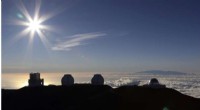
The Sun is a hot ball of glowing gases, mostly hydrogen and helium. It is the largest object in the Solar System, and it contains over 99% of the mass of the Solar System. The Sun's surface temperature is about 5,778 K (5,505 °C; 9,941 °F), and its core temperature is about 15,000,000 K (15,000,000 °C; 27,000,000 °F). The Sun emits energy in the form of light, heat, and other types of radiation.
The planets are smaller objects that revolve around the Sun. They are made up of rock, ice, and gas. The planets do not produce their own light, but they reflect sunlight.
The planets are divided into two groups: the inner planets and the outer planets. The inner planets are Mercury, Venus, Earth, and Mars. They are closer to the Sun than the outer planets. The outer planets are Jupiter, Saturn, Uranus, and Neptune. They are farther from the Sun than the inner planets.
The planets have different characteristics, such as their size, mass, composition, and atmosphere. The planets also have different moons, rings, and other features.
The Sun and the planets are part of a larger system called the Milky Way Galaxy. The Milky Way Galaxy is a spiral galaxy that contains billions of stars, planets, and other objects.