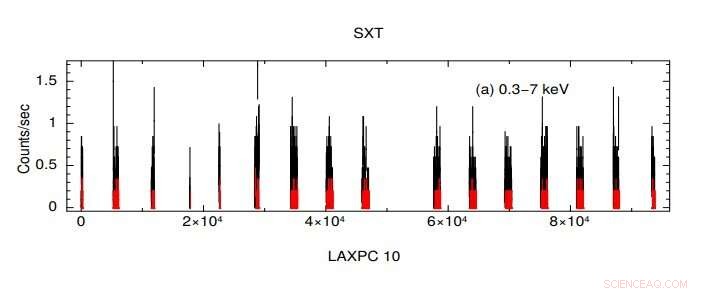
The SXT lightcurve of 3A 0726-260 in 0.3-7 keV energy range. Credit: Roy et al., 2020.
Using AstroSat satellite, Indian astronomers have detected strong X-ray pulsations from an X-ray binary pulsar known as 3A 0726-260. The discovery, presented in a paper published April 26 on the arXiv pre-print repository, sheds more light on the nature of this poorly studied object.
X-ray pulsars (also known as accretion-powered pulsars) are sources displaying strict periodic variations in X-ray intensity, consisting of a magnetized neutron star in orbit with a normal stellar companion. In these binary systems, the X-ray emission is powered by the release of gravitational potential energy as material is accreted from a massive companion. X-ray pulsars are among the most luminous objects in the X-ray sky.
Located some 20,000 light years away, 3A 0726-260 (other designation 4U 0728-25) is one of the least-studied X-ray binary pulsars, despite being a persistent X-ray emitter at luminosity level of about 100 decillion ergs/s during its non-flaring states. The system has orbital period of approximately 34.55 days and contains an X-ray pulsar with spin period of about 103 seconds.
A team of astronomers led by Jayashree Roy of the University of Mumbai, India, investigated 3A 0726-260 in detail. Their study was based on the data from AstroSat's Large Area X-ray Proportional Counter (LAXPC) and Soft X-ray Telescope (SXT).
"We present results from broadband (0.3-40 keV) study of the source using data from AstroSat observations with the SXT and the LAXPC detectors," the astronomers wrote in the paper.
The observations detected strong X-ray pulsation with a period of 103.144 seconds. This suggests that there has been only a marginal change in the spin period of the pulsar since last measurements conducted in 1997. Moreover, weak pulsations from the source in 20-40 keV range were detected for the first time in the LAXPC data.
In general, the pulse profile of 3A 0726-260 was found to be energy dependent. It appears that the pulse shape changes from a broad single pulse, up to 5.0 keV, to a double pulse at higher energy (aboe 5.0 keV). The researchers offer two hypotheses that could explain such behavior.
"The change in the pulse profile from a single peak to a weak double peaked structure may be explained by intrinsic change occurring in the beaming pattern from a pencil beam to a fan beam which results in the beam to move out of our line of sight (...). The change in the pulse profile can also be attributed to a transition in accretion pattern from a smooth accretion stream at low energies to several narrow accretion streams at high energy that are phase-locked with the neutron star," the paper reads.
The study also detected the presence of an of broad 1.06 keV, iron K-alpha line at approximately 6.3 keV. The astronomers added that 3A 0726-260 is accreting at almost a steady accretion rate with no indication of any instability that could trigger outbursts from this source.
© 2020 Science X Network