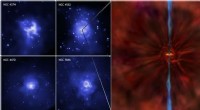
New Webb data has shed light on the end of the Dark Ages with evidence that the Universe's first luminous objects were born just a few hundred million years after the Big Bang.
* The James Webb Space Telescope detected faint galaxies just slightly older than the previous records, but much larger than expected, which may reveal the nature of these very first galaxies.
* The Hubble Space Telescope observed the galaxies just after this epoch and caught galaxies beginning to build up.
* The galaxies observed by Webb and Hubble hold the key to understanding how the Dark Ages ended and gave rise to the Universe we see today.
The James Webb Space Telescope (Webb) is delivering on its promise to revolutionize our understanding of the Universe, and a recent study using Webb's data has provided new insights into one of the most mysterious eras in cosmic history: the Dark Ages.
The Dark Ages occurred in the early Universe, shortly after the Big Bang. During this time, the Universe was filled with a thick fog of neutral hydrogen gas that blocked out most light. As a result, the Dark Ages were a time of darkness and mystery, and astronomers have been eager to learn more about this period.
Webb has now observed a number of galaxies that date back to the end of the Dark Ages. These galaxies are so far away that their light has taken over 13 billion years to reach us, meaning that we are seeing them as they were when the Universe was only a few hundred million years old.
The galaxies observed by Webb are much larger than expected, and they are also forming stars at a much faster rate than previously thought. This suggests that the end of the Dark Ages may have been a more rapid and dramatic process than previously believed.
The Webb observations are also providing new insights into the nature of the first stars and galaxies. These objects were likely very different from the galaxies we see around us today, and they may have played a key role in shaping the evolution of the Universe.
The data from Webb is still being analyzed, but it is already clear that this revolutionary telescope is providing astronomers with a wealth of new information about the Dark Ages and the early Universe. As we continue to learn more about this era, we will gain a better understanding of how the Universe came to be.