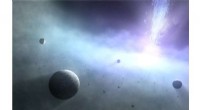
Scientists used to think that Mercury was made of leftover rocks from the solar system's chaotic formation that happened about 4.5 billion years ago. However, more recent research has suggested that a protoplanet once nearly as massive as Mars occupied Mercury's orbit. After a giant impact with another protoplanet known as Theia or Thor, this Mars-sized world could have disintegrated, leaving only the core of that protoplanet as the modern-day Mercury.
Asphaug and his team found that, in computer simulations of the giant impact theory, the best match for Mercury's final composition is a scenario in which the two colliding planets had very similar temperatures. This means the two protoplanets formed relatively close together in the solar system, and this could help astronomers better place Mercury in the broader scheme of the evolution of the solar system.
The team also found that Mercury must have lost about 90 percent of its volatile material, such as water ice, in the giant impact. This finding is consistent with current models of the young sun and how its radiant heat could boil away volatile material from Mercury.
The team, which also included scientists from Tel Aviv University and MIT, ran more than 14,000 computer simulations of giant impact scenarios between two protoplanets. By varying initial conditions such as the size and velocities of the two colliding planets, as well as the impact angle, the scientists were able to assess the likely outcomes of thousands of different scenarios and how well each result matches the geophysical characteristics of Mercury that are known from spacecraft measurements.