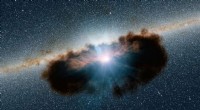
A recent study sheds doubt on the previously proposed association between a high-energy neutrino detection and a nearby star being devoured by a black hole. Instead, the new analysis suggests that the neutrino likely originated from a powerful jet launched by a supermassive black hole located at the center of a distant galaxy.
Detailed Summary:
In September 2017, the IceCube Neutrino Observatory, located at the South Pole, detected a high-energy neutrino known as IceCube-170922A. Initially, there was excitement when a nearby galaxy called NGC 1068 seemed to offer a compelling cosmic source—a star consumed by a supermassive black hole at the galaxy's heart. This scenario seemed to fit nicely with theoretical predictions about neutrino production mechanisms associated with such events.
However, a new study led by researchers at Radboud University in the Netherlands challenges this proposed connection. By performing detailed observations with various telescopes, including the Hubble Space Telescope, and conducting extensive numerical simulations, the scientists evaluated whether NGC 1068 could indeed be the neutrino's birthplace.
Their analysis revealed several discrepancies. The observed brightness and variability of NGC 1068's jet, powered by the supermassive black hole at its core, did not align with expectations for the proposed stellar devouring scenario. The team's simulations further indicated that the jet of NGC 1068 lacked sufficient energy to accelerate protons to energies high enough to produce neutrinos through interactions with ambient gas clouds.
Instead, the study suggests an alternative source for the detected neutrino. Blazars—a type of highly active galaxy with powerful jets pointed toward Earth—emerged as more likely candidates. The direction of IceCube-170922A aligns with several known blazars, and blazar jets are known to accelerate particles to extremely high energies, making them capable of producing neutrinos through interactions with photons or gas in the blazar's vicinity.
The findings highlight the complexity of identifying and understanding the cosmic origins of high-energy neutrinos. While they present a unique window into extreme astrophysical processes, pinpointing their exact sources remains a challenging endeavor that often requires detailed investigations and considerations of multiple potential scenarios.