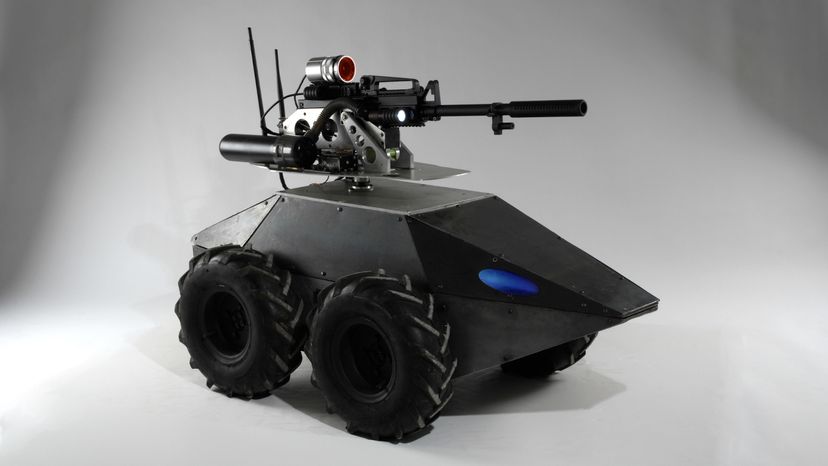
Everyone knows that being a soldier is a dangerous job, but some of the tasks that soldiers are required to do are more dangerous than others. Walking through minefields, deactivating unexploded bombs or clearing out hostile buildings, for example, are some of the most dangerous tasks a person is asked to perform in the line of duty.
What if we could send robots to do these jobs instead of humans? Then, if something went wrong, we'd only lose the money it cost to build the robot instead of losing a human life. And we could always build more robots.
The U.S. military has been developing robotic systems for all sorts of jobs for years now, and some of them are even on the front lines in Iraq. In this article, we'll meet some of the military's latest robot soldiers, find out what sorts of jobs they can do and get a glimpse of what the future holds for military robots.
If you're interested in some background on the subject of robots in general before you learn about military-specific robots, check out How Robots Work.
Now, let's get started.
Contents This version of the ACER robot clears anti-personnel landmines.
Photo courtesy Mesa Robotics
This version of the ACER robot clears anti-personnel landmines.
Photo courtesy Mesa RoboticsThe military doesn't use the kinds of humanoid assault robots we've come to expect from films like "The Terminator." Whether or not a robot looks like a human doesn't matter much in today's military applications. Robots come in many shapes and sizes, and although there isn't really any single definition of a robot, one common definition is this: a machine that is controlled, in whole or in part, by an onboard computer. Robots also have sensors that allow them to get information from their surroundings, some form of locomotion and a power source.
If military robots aren't shaped like humans, what shapes do they come in? It depends on the kinds of jobs the robot is built to carry out. Robots that have to negotiate difficult terrain use tank treads. Flying robots look pretty much like small airplanes. Some robots are the size of trucks, and they look pretty much like trucks or bulldozers. Other, smaller robots have a very low profile to allow for great maneuverability.
Today's military robots don't do a whole lot on their own. Their computer brains aren't very sophisticated in terms of artificial intelligence (AI). AI is a form of computer program that allows the robot to process information and make some decisions on its own. Instead of independent AI, most military robots are remote-controlled by human operators. The military doesn't usually use the term "robot" -- it calls them unmanned ground vehicles (UGVs) or unmanned aerial vehicles (UAVs).
 The 61-pound (28-kg) MATILDA robot can tow up to 475 lbs (215 kg).
Photo courtesy Mesa Robotics
The 61-pound (28-kg) MATILDA robot can tow up to 475 lbs (215 kg).
Photo courtesy Mesa RoboticsOne other important thing to remember about military robots: Robots designed to help soldiers on the battlefield have to be carried onto the battlefield by those soldiers. For that reason, robot builders try to design "man-portable" designs. A man-portable robot can be carried by a single soldier, usually in a special backpack.
Next, we'll find out why smaller is sometimes better when it comes to military robots.
 TALON configurations
Photo courtesy Foster-Miller
TALON configurations
Photo courtesy Foster-Miller
The most common robots currently in use by the military are small, flat robots mounted on miniature tank treads. These robots are tough, able to tackle almost any terrain and usually have a variety of sensors built in, including audio and video surveillance and chemical detection. These robots are versatile, with different sensor or weapon packages available that mount to the main chassis. Virtually all of them are man-portable.
The TALON is a man-portable robot operating on small treads. It weighs less than 100 lbs (45 kg) in its base configuration. TALON is designed to be very durable -- one of the robots reportedly fell off a bridge and into a river in Iraq. Some time later, the soldiers set up the TALON's control unit and simply drove it out of the river [ref]. That brings up another important feature of the TALON -- it's amphibious.
TALON is operated with a joystick control, has seven speed settings (top speed is 6 feet/1.8 meters per second) and can use its treads to climb stairs, maneuver through rubble and even take on snow.
Versatility has been designed into the TALON as well, with multiple possible configurations available that adapt the robot to the situation at hand. The basic TALON includes audio and video listening devices and a mechanical arm. A lightweight (60-lb/27-kg) version omits the arm. TALONs were used for search and rescue at WTC Ground Zero, and they have been used in Bosnia, Afghanistan and Iraq for the disposal of live grenades, improvised explosive devices and other dangerous explosives.
Recently, the TALON was prepared to take on an even bigger role. All TALONs are now equipped with chemical, gas, temperature and radiation sensors. The military is even running tests on TALONs that carry guns. "TALON robots can be configured with M240 or M249 machine guns or Barrett 50-caliber rifles," according to manufacturer Foster-Miller.
 Assault TALON
Photo courtesy Foster-Miller
Assault TALON
Photo courtesy Foster-Miller
The military is performing additional tests using TALON robots equipped with grenade launchers and anti-tank rocket launchers.
For complete TALON specifications, see Foster-Miller: TALON Robot.
Robots Run Amok?The thought of robots motoring around with deadly weapon systems mounted on them is disquieting to many people. Could a robot go berserk and start shooting at people indiscriminately?
Military officials and robot designers say this is almost impossible. The robots don't operate autonomously very often, relying on remote human operators most of the time. Even if a robot with a gun were allowed to operate on its own, and it did go out of control, the push of a button on the control unit is all that would be needed to reboot the robot to safe mode.
Read More A Packbot Scout searches for booby traps on this truck at Najaf airfield, Iraq, on March 31, 2004.
Photo courtesy Army Public Affairs
A Packbot Scout searches for booby traps on this truck at Najaf airfield, Iraq, on March 31, 2004.
Photo courtesy Army Public AffairsThe Packbot is another small robot that operates on treads. It's even smaller and lighter than the TALON, weighing in at about 40 lbs (18 kg) in the basic Scout configuration. Packbot is man-portable and is designed to fit into the U.S. Army's new standard pack, the Modular Lightweight Load Carrying Equipment (MOLLE).
Controlled by a Pentium processor that has been designed specially to withstand rough treatment, Packbot's chassis has a GPS system, an electronic compass and temperature sensors built in. Packbot manufacturer iRobot says Packbot can move more than 8 mph (13 kph), can be deployed in minutes and can withstand a 6-foot (1.8-meter) drop onto concrete -- the equivalent of 400 g's of force.
U.S. soldiers regularly take advantage of this ruggedness, tossing Packbot through windows of hostile buildings and then using it to search and find out where enemy combatants are hiding. Even if Packbot lands upside down, it can right itself using powerful treaded flippers, which also help it climb obstacles.
 Packbot motion
Packbot comes in several different versions in addition to the basic Scout unit. Packbot Explorer adds a square "head" that can raise up on a metal arm, pan and tilt, provide gun-sighting video and generally act as a lookout for soldiers who need to peer over obstacles or around corners. Packbot EOD is used to disarm or safely detonate dangerous explosives. It uses a mechanical arm with a gripping hand plus a full range of audio and visual sensors.
 Packbot Explorer
Photo courtesy U.S. Army
Packbot Explorer
Photo courtesy U.S. ArmyWith eight modular payload ports, Packbot is built for further customization.
For complete Packbot specifications, see iRobot: Packbot.
 MATILDA with mechanical arm
Photo courtesy U.S. Army: Redstone Arsenal
MATILDA with mechanical arm
Photo courtesy U.S. Army: Redstone ArsenalMATILDA (Mesa Associates' Tactical Integrated Light-Force Deployment Assembly), made by Mesa Robotics, is similar to other small robot designs but has a higher profile due to its triangular tread shape. It weighs 61 lbs (28 kg) with the batteries, can be carried by one or two people and fits in the trunk of a car.
MATILDA has numerous possible configurations. For instance, it can be equipped with a mechanical arm or a variety of cameras and sensors, and it can even tow a small trailer.
 Three of MATILDA's possible configurations
The robot has a top speed of 3 feet (1 meter) per second and a single-charge run time of four to six hours. In the event of tread damage, the quick-change tracks can be swapped in about five minutes.
 Matilda Manipulator
Photo courtesy Mesa Robotics
Matilda Manipulator
Photo courtesy Mesa Robotics*Source: Mesa Robotics: Performance Specifications and Features
Mesa Robotics is also developing the lightweight MAUD robot and the low-cost MARV, a treaded robot designed to be expendable.
 MARV
Photo courtesy Mesa Robotics
MARV
Photo courtesy Mesa Robotics MAUD weighs less than 30 pounds (14 kg).
Photo courtesy Mesa Robotics
MAUD weighs less than 30 pounds (14 kg).
Photo courtesy Mesa RoboticsIn the next section, we'll learn about some larger military robots.
 Armored Combat Engineer Robot (ACER)
Photo courtesy Mesa Robotics
Armored Combat Engineer Robot (ACER)
Photo courtesy Mesa RoboticsLarger military robots are basically trucks or tanks with computers in them, operated by remote control.
ACER is another robot made by Mesa Robotics. This robot is about the size of a small bulldozer or a Zamboni.
ACER can handle many heavy-duty tasks, such as clearing out explosives with a mechanical arm, clearing and cutting obstacles down with a plow blade or a giant cutter, pulling disabled vehicles (up to and including buses), hauling cargo in a trailer and serving as a weapons platform. This robot can roll along with a mine-sweeper attached to the front, clearing a field of anti-personnel mines before any humans have to walk there.
 Three of ACER's possible configurations
One of ACER's more innovative uses is as a firefighting/decontamination platform. Equipped with a pan-and-tilt nozzle, ACER can pull its own supply of foam retardant or decontaminant in a 350-gallon (1,325-liter) tank. A nozzle can also be mounted on a mechanical arm for very precise aiming.
 Photo courtesy Mesa Robotics
Obviously, ACER is not man-portable -- it weighs 4,500 lbs (2,040 kg). This heavy-duty robot has a maximum speed of 6.3 mph (10 kph) and runs on a diesel engine. The fuel tank holds 19 gallons (72 liters). For complete ACER specifications and features, see Mesa Robotics: ACER.
 ARTS, equipped with a Harley Box Rake, begins explosive-ordnance disposal activities.
Photo courtesy AFRL Materials and Manufacturing Directorate
ARTS, equipped with a Harley Box Rake, begins explosive-ordnance disposal activities.
Photo courtesy AFRL Materials and Manufacturing DirectorateThe All-Purpose Remote Transport System (ARTS) was developed by the U.S. Air Force for one purpose -- the help dispose of dangerous explosives. ARTS is basically a bulldozer, but instead of a bulldozer's blade, it has mine-clearing devices, a mechanical arm and a water cutting tool attached. ARTS can be remotely operated from a distance of up to 3 miles (5 km) with line of sight. It can also set charges to detonate explosives from a distance. ARTS weighs 7,500 lbs (3,400 kg).
The Robotic Armored Assault System (RAAS) and the Armed Robotic Vehicle (ARV) are both in development by the U.S. military. These are large-scale robots (ARV will weigh 5 to 6 tons) capable of carrying up to 1 ton of payload.
Potential weapons to be mounted on these tank-size robots include the 30mm Mk 44 chain gun or a turret system capable of firing Hellfire missiles. They have been designed so that they can be carried and deployed by the military's primary cargo-carrying aircraft, the C-130 and the CH-47.
 U.S. Air Force C-130 Hercules aircraft
Photo courtesy Department of Defense
U.S. Air Force C-130 Hercules aircraft
Photo courtesy Department of DefenseIn the next section, we'll meet some robots that can take to the air.
More Than MilitaryAlthough the robots in this article were designed primarily for use by military forces, they have civilian uses as well. Law enforcement agencies use robots to disarm or detonate explosives -- there's a good chance there's a robot on your local police force. Unmanned assault robots and scout robots can be useful in armed standoff situations.
Health and safety officials and fire departments are finding uses for these robots as well. Industrial fires can be deadly for firefighters because they can never be sure if there are explosive chemicals involved. Sending in a robot to check it out can save lives. The ability of robots to safely investigate and decontaminate hazardous materials might make them regular staff members at major hospitals and on Hazmat teams.
Read More Northrop Grumman RQ-4A Global Hawk
Photo courtesy Air Force Link
Northrop Grumman RQ-4A Global Hawk
Photo courtesy Air Force Link
The military uses several different flying robots, mainly for reconnaissance. Instead of UGVs, these are known as UAVs (unmanned aerial vehicles), and they are sometimes referred to as drones. UAVs look like model aircraft, and they range in size from small planes that can be held by a person and launched with a good throw, like the FQM-151 Pointer, to full-size airplanes that operate by remote control, like the RQ-4A Global Hawk.
Global Hawk Specifications
Pointer Specifications
 AeroVironment FQM-151 Pointer
Photo courtesy AeroVironment, Inc.
AeroVironment FQM-151 Pointer
Photo courtesy AeroVironment, Inc. AeroVironment FQM-151 Pointer
Photo courtesy AeroVironment, Inc.
AeroVironment FQM-151 Pointer
Photo courtesy AeroVironment, Inc. MQ-1 Predator UAV
Photo courtesy U.S. Air Force
MQ-1 Predator UAV
Photo courtesy U.S. Air ForceReconnaissance plays a key role in military planning -- drones help military commanders keep track of their own troops and also spot enemy troops that might be waiting to ambush U.S. soldiers.
Flying robots like the Predator provide constant real-time data on troop movements, enemy locations and weather. In at least one case, a flying robot did a lot more than just spot the enemy: Predators can be fitted with Hellfire missiles, and when one of these Air Force drones spotted an anti-aircraft gun in southern Iraq in March 2003, it used one of the Hellfires to take it out [ref].
 The MQ-1 Predator Hunter/Killer is equipped with two Hellfire missiles and a targeting system.
Photo courtesy U.S. Air Force
The MQ-1 Predator Hunter/Killer is equipped with two Hellfire missiles and a targeting system.
Photo courtesy U.S. Air ForceTo learn much more about the Predator, see How the Predator UAV Works.
Today's military robots are limited in their autonomy and their range. They are essentially tethered to human controllers. The Defense Advanced Research Projects Agency (DARPA), the U.S. government entity that funds and develops new technologies for military use, recently held a widely publicized robot race to see how far along robot AI had come. It turns out that AI is still pretty limited -- not a single robot completed the course. So even as the abilities of robots increase, it seems that for the foreseeable future, a human soldier will still be required at the control unit.
For more information on military robots, check out the links on the following page.
Sources