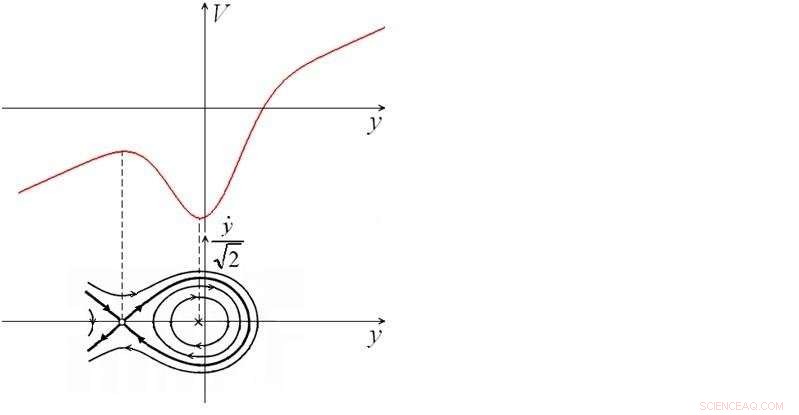
Phase trajectories for a social system in a conflict situation without external interference. Credit: Lobachevsky University
A team of researchers led by Associate Professor Alexander Petukhov of the Institute of International Relations and World History at Lobachevsky University is developing social conflict models on the basis of nonlinear dynamics.
For mathematical modeling, an important feature of social and political processes is that they cannot be strictly defined. They are always subject to small changes and fluctuations. Quite often, social processes are compared to Brownian particles. These small changes (fluctuations) in their trajectory are explained by the chaotic motion of other molecules. In social processes, fluctuations can be regarded as manifestations of their individual participants' free will, as well as other random manifestations of the external environment.
In physics, these processes are usually described by Langevin's stochastic diffusion equation, which has also been applied to model certain social processes.
The approach based on such equations has several advantages:
The model is based on the idea that individuals interact in society through a communication field—h. This field, which is created by each individual in society, models the information interaction between individuals.
However, it should be understood that this is a society that is hardly attributable as an object in classical physical spatial topology.
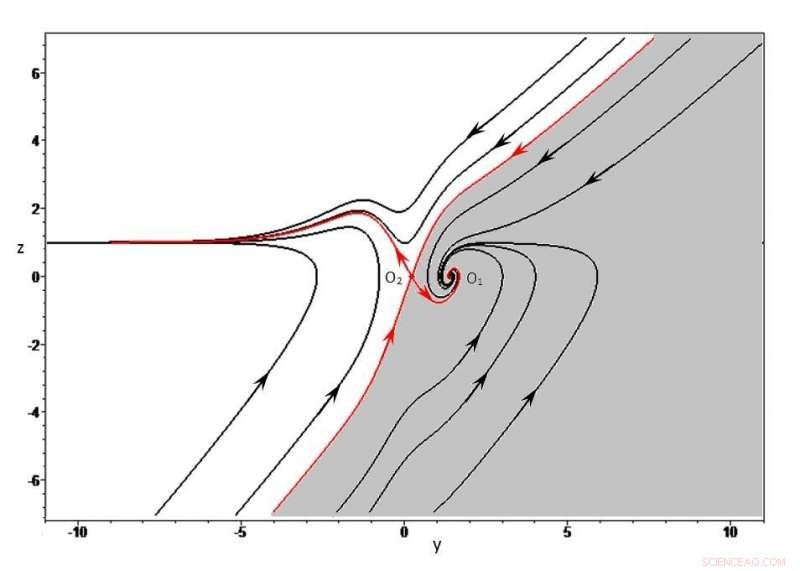
Phase trajectories for a social system in a conflict situation with external interference. Credit: Lobachevsky University
According to Dr. Petukhov, from the point of view of information transfer between individuals, the space in society combines both classical spatial coordinates and additional specific features. This is explained by the fact that in the modern information world, there is no need to be close to the object of influence in order to convey information to this object.
"Thus, society is a multidimensional, social and physical space reflecting the ability of one individual to 'reach' another individual with his communication field, that is, to influence that individual, his parameters and the ability to move in a given space," notes Alexander Petukhov.
Accordingly, the individual's position relative to other individuals in such a space provides a model of the level of the relationship between them and of their involvement in information exchange. When individuals are located close to each other in this model, it means that there is a regular exchange of information between them, and a social connection has been established. In this context, the variant of interaction between individuals or groups of individuals resulting in a dramatic increase in the distance (i.e., the social distance Δx = xi—xj, where x is the coordinate in the social and physical space, i, j = [1, N], where N is the number of individuals or consolidated groups of individuals) between them should be considered a conflict.
Therefore, assuming that an individual is similar to a Brownian particle with a certain radius of influence on other individuals, the communication field can be represented using the diffusion equation.
Based on the approach presented above and the model developed by Lobachevsky University researchers, the following characteristic patterns and dependences on the initial and boundary conditions were revealed:
It was also proved in the course of these studies that the transition of a distributed multicomponent cognitive system from a stable state to an unstable one is a threshold effect. According to Alexander Petukhov, the experiments performed by Lobachevsky University researchers have revealed the specific parameters required to control such a system: They determine the transition from a stable state to an unstable one, which makes it possible, with full control of such parameters, to create conditions for the emergence of a social conflict, or, on the contrary, to prevent it.
"By developing this approach in the future, we will be able to create on its basis a tool for adequate forecasting of social conflicts", Alexander Petukhov says.