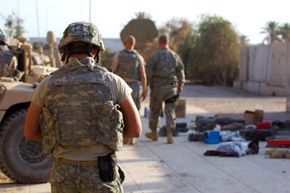
Picture an Army unit at a remote location in Afghanistan. If they're going to do their jobs, and if they're going to be as healthy and safe as possible, the troops there need a lot of supplies. They need food, ammunition, replacement parts, uniforms, medical supplies, weapons and other items. It's crucial that they get what they need, when they need it.
Wherever Army units are, the people who provide them with the things they need are vitally important. They're Army unit supply specialists, or, in Army parlance, the soldiers whose jobs are numbered MOS 92Y. (MOS stands for Military Occupational Specialty; 92Y is a military designation.)
The Army uses several factors to decide what a person's MOS will be. One is the Armed Services Vocational Aptitude Battery (ASVAB), a multiple-choice test given to anyone interested in enlisting. Another is the Army's needs and vacancies in particular jobs. A third is an enlistee's interest in a job.
According to the U.S. Army, someone might be suited for a unit supply specialist job if he or she:
Army unit supply specialists are important -- and often busy. Keep reading to find out more about what they do.
Unit supply specialists are responsible for making sure that the Army's supplies and equipment are kept in good condition, are well documented and are distributed as needed.
There are five basic skill levels within the 92Y MOS. As unit supply specialists advance to higher skill levels, they take on more responsibility for supervising, assisting, inspecting and training those in lower levels. At skill level 5, the highest, a Unit Supply Specialist may be involved in developing plans and operations to improve the way supplies are handled. He or she may act as a liaison to the units that are being supplied.
The duties that unit supply specialists perform depends upon where they're stationed and what the needs are there. One unit supply specialist may spend a lot of time at a desk using computers and telephones. Another may work at airfields and/or warehouses, dealing with trucks or forklifts.
These are some typical tasks carried out by unit supply specialists:
Read on to learn how the Army trains its unit supply specialists.
Like people being trained for any job, those who will become unit supply specialists spend their first nine weeks in the Army in basic training, a.k.a. boot camp. In boot camp, recruits learn everything it takes to be a soldier. They learn discipline, Army values and how to conduct themselves. They learn how things are done in the Army. They have intensive physical conditioning and are taught about weapons and combat skills.
After boot camp, the next step is eight weeks at the U.S. Army Quartermaster School at Fort Lee, Va., for advanced individual training specific to being a unit supply specialist. The training combines classes with practical experience. Trainees will also learn about:
Unit supply specialists are involved in some of the Army's most cutting-edge training. A pilot program of the Army Capabilities Integration Center (ARCIC) loads training modules on iPhones to provide trainees with information to supplement their regular training [source: Montgomery].
The training and experience of Unit supply specialists can help them find civilian jobs after their military service handling stock, parts and related records in factories, department stores, warehouses and stockrooms. Such jobs are available both in the private sector and in government.
Keep reading for lots more information on military careers.
The World's Most Famous Army Unit Supply SpecialistArguably, the most renowned Army unit supply specialist in recent history was PFC Jessica Lynch, a 19-year-old West Virginia native who was injured and captured by Iraqi forces during the U.S. invasion of Iraq, on March 23, 2003. On April 1, U.S. forces rescued her. Lynch, a supply clerk with the 507th Maintenance Company out of Fort Bliss, Texas, was initially listed as missing in action. Military officials initially presented her story as one of her heroism, but she later testified and wrote that she never fired her gun because it jammed and she was unconscious when captured.