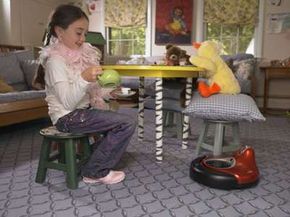
iRobot, a company founded by Massachusetts Institute of Technology roboticists, recently revealed the revolutionary ConnectR. Its newest robot looks a little bit like a curling stone, with a reddish-orange color reminiscent of the set of "2001: A Space Odyssey." The company has had success with its other robots, including the Roomba, a robot vacuum cleaner; the Scooba, a robot mop; and the Verro, which cleans pools. A gutter-cleaning robot, the Looj, was revealed by the company the same day as the ConnectR.
Robot Image Gallery
But the ConnectR is different from its siblings. Rather than to serve a strictly utilitarian function like cleaning floors, it was created for social purposes. As a virtual presence, the household bot is meant to keep far-off relatives and late-working parents connected to their families.
The robot is based on the Roomba design and features two high-resolution video cameras along with a two-way audio system. It can be controlled remotely, so fretful homeowners can look in on their house when they're away, and adept users could even conceivably play fetch with their dog remotely. Parents can play hide-and-seek with their child, grandparents can read a book to their grandchildren, and vacationing families can check up on the cat while they're away.
Since the ConnectR is mobile, the "host" family doesn't have to stop what it's doing to have a conversation with a distant relative. The robot ostensibly serves as a stand-in, and conversations can take place in much the same manner that they would if everyone were in the same room.
So how does it work? The ConnectR is based on the Roomba design, so it's highly mobile and won't tip over easily. But the company doesn't say anything about stairs, and traditionally, Roombas have a difficult time with stairs and tend to avoid them entirely through their design.
The ConnectR's audio-visual equipment is what separates the robot from its siblings and makes the ConnectR a virtual presence.
It sounds like the ConnectR could enable families to stay closer, but there may be some kinks left in the robot's design. Read the next page to see some of the potential problems associated with the ConnectR.
 Could it be used to gauge theviciousness of your family's dog?
Image courtesy iRobot
Could it be used to gauge theviciousness of your family's dog?
Image courtesy iRobotiRobot's ConnectR is a far cry from what the science-fiction writers of a few decades ago envisioned a social robot would be, but is it a first step? Does ConnectR represent the real beginning of robot-kind?
Perhaps, but we won't have to worry too much about ConnectR taking over the world, like many of those same science-fiction writers predicted. The product doesn't have any intelligence of its own; it's controlled by the humans who use it. Aside from its surveillance capabilities, the robot is fairly innocuous. Even if all ConnectRs revolted against their families, the result would amount to little more than a lot of bruised ankles and crushed ConnectRs.
Still, there are some potential problems with the ConnectR. Security is one of them. The ConnectR software requires users to enter a phone number for the VoIP connection and a personal identification number (PIN). Each robot is programmed for up to 10 separate PINs, and it allows access by one user at a time. iRobot supposes that this information will be guarded as a secret by the family, but family secrets do have a way of being leaked to non-family members.
The ConnectR's function is meant to be purely social, and iRobot envisions its product as a means of keeping family members in the loop. But the ConnectR could also enable unwanted visitors to be connected as well. Hackers may find a way to use the ConnectR to case a house, check on the viciousness of the family dog or ensure that no one is home before breaking in. That problem is easily remedied using the ConnectR's privacy mode, which shuts off the robot's cameras and audio. This can be a two-way street, however. ConnectR owners who are away at work could use their robot to inspect their home for intruders. If homeowners disable their robot before they leave the house, hackers won't be able to access it -- but neither will the homeowners.
iRobot has taken steps to protect its ConnectRs against unwanted users. In addition to the passwords and unlisted VoIP phone numbers, the ConnectRs operate via iRobot's secure wireless network, its virtual presence network (VPN). But since the company alone controls the VPN, this means that select iRobot employees could have access to all of the ConnectR feeds in use at any given time, as well as any information passed through its network. This could possibly deter people who really value their privacy from buying the robot.
Will the ConnectR's potential pitfalls keep the world from adopting this social robot? That won't become clear until the market research comes in. Early adopters have a chance to get their hands on a ConnectR for $200 as part of the company's pilot program. By agreeing to fill out a few surveys and participate in an interview, select consumers can get one before they're widely released for $500 in 2008.
For more information on ConnectR, visit the next page.
Erector's SpykeeRobot lovers who want a virtual presence robot that also protects the house may want to look into the toy company . Like the ConnectR, Spykee offers VoIP two-way audio, one-way video and mobility. But Spykee also has motion sensors. Owners can set the robot near a door or window, and when it senses an intruder, the robot can snap a photo and e-mail it to its owner [source: AP].